
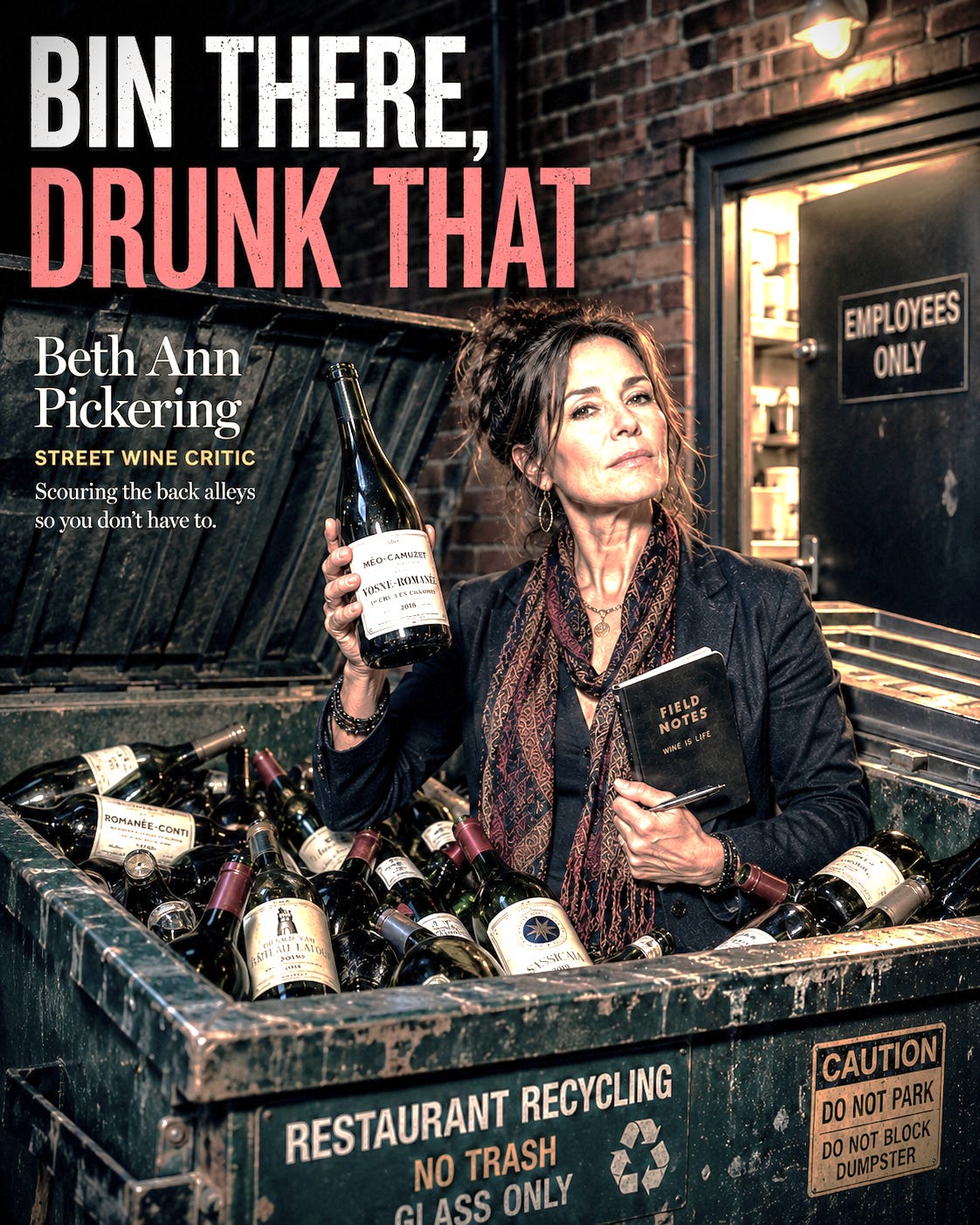
Bin There, Drunk That
By Beth Ann Pickering - Street Wine Critic - Indelible Wine Stain

“When Critics Get Paid and I Get Dumpsters”
Let me start with a confession.
I didn’t always rifle through recycling bins outside of award-winning wine bars or sneak into hotel kitchens to sip half-empty Grand Cru Burgundy.
Once upon a time, I wore silk scarves, held stemware with grace, and spent my weekends judging regional sommelier competitions.
I knew my Clos de Tart from my Clos du Boi.
I could explain the difference between Manzanilla and Fino to complete strangers without them visibly checking their watches.
I had a career.
Then came the sherry bar.
Everyone said it was a good idea.
“They’re all doing it in London,” they said.
“New York is ready,” they said.
“Sherry is the future,” “they” said.
Convinced I was standing on the cutting edge of a revolution; I invested everything I had into an Atlantic City bar called “Amontillado on my Mind.”
In hindsight, there may have been certain flaws in the business plan.
For example, nobody their appeared to be interested in discussing biologically aged Palomino at eleven o’clock on a Tuesday morning…or at any time actually.
Six months later, I was bankrupt.
A year later, I was writing wine articles.
Today, I am writing wine articles whilst crouched behind a luxury hotel recycling container looking for the Angel’s share, the splish of a Frédéric Mugnier, Chambolle-Musigny, Les Amoureuses that was left-over and needs a good home…and needs an authentic wine review.
I will explain.
Life comes at you fast.
But I still taste. I still write.
And unlike most critics, I can guarantee you one thing:
Nobody pays me to say anything.
Not because I’m particularly noble.
It’s because nobody’s offering and I can’t afford samples.
Of course, this creates a small logistical problem.
Wine critics are generally expected to taste wine.
Ideally before reviewing it.
I would hope that they do, anyway.
Unfortunately, bankruptcy had done little to improve my access to La Conseillante, DRC Romanée-Conti, Spottswoode Cabernet Sauvignon or Rose & Arrow Stonecreek.
So, I adapted.
Some critics receive samples.
Some attend trade tastings.
Some travel the world courtesy of regional promotional boards.
I built a network.
Over the years I have cultivated relationships with waiters, bartenders, sommeliers, banquet captains, dishwashers, valet attendants and at least one maître d’ who still owes me fifty dollars.
Most of them are good people.
All of them have my number.
At any moment my phone may buzz.
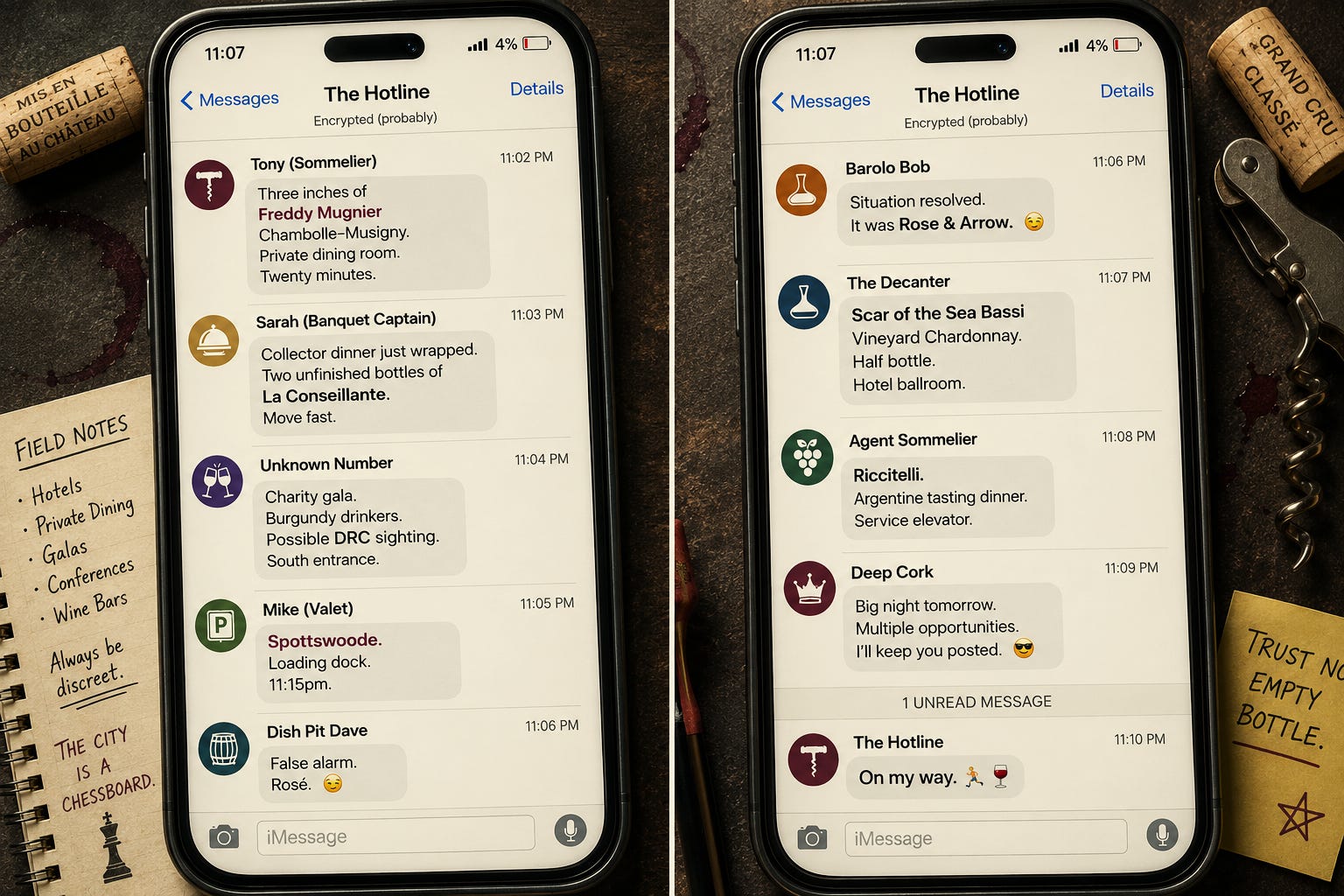
Then it’s a race against time.
The city becomes a chessboard.
I have crossed Manhattan for less than an ounce of wine.
One time sharing a tourist bicycle taxi that blared Cher and ruined my hair.
I once drove forty-five minutes through a thunderstorm because a banquet server reported an abandoned bottle of Castillo Ygay Rioja.
By the time I arrived, there were only two glasses left.
It was worth it.
To some, this may sound ridiculous.
To me, it is simply independent wine journalism supported by an exceptionally dedicated field research team.

Why I’m Anti-Pay-To-Play…and why you should be too
Wine criticism has a funny little problem.
Not a conspiracy. Not corruption. Just incentives.
Most wine writers are not getting rich.
They’re not driving Bentleys through Napa Valley.
They’re freelancers, journalists, writers and enthusiasts trying to make a living in an industry that rarely pays enough to cover the parking.
And that’s where things get complicated.
A critic gets invited to a tasting.
Then another tasting.
Then a winemaker dinner.
Then a press trip.
Then a weekend in Tuscany.
Then a few carefully selected sample bottles arrive at the door.
Then another case.
Then another.
Before long they’re spending three days eating truffle pasta with winemakers, watching sunsets over vineyards, staying in luxury charming boutique hotels arranged by regional promotional boards, and returning home to write independent tasting notes on the very wines they were sipping beside the pool at the luxury charming boutique hotels.
Human beings are funny like that.
The wine industry has developed an entire ecosystem of samples, hosted tastings, sponsored events, educational trips, media partnerships, promotional packages and enough complimentary lunches to feed a medium-sized European nation.
In some corners of the wine world, producers can purchase reports, assessments, consulting packages, promotional opportunities and enough adjectives to fill a thesaurus.
Somewhere along the line, it became increasingly difficult to determine where criticism ended and marketing began.
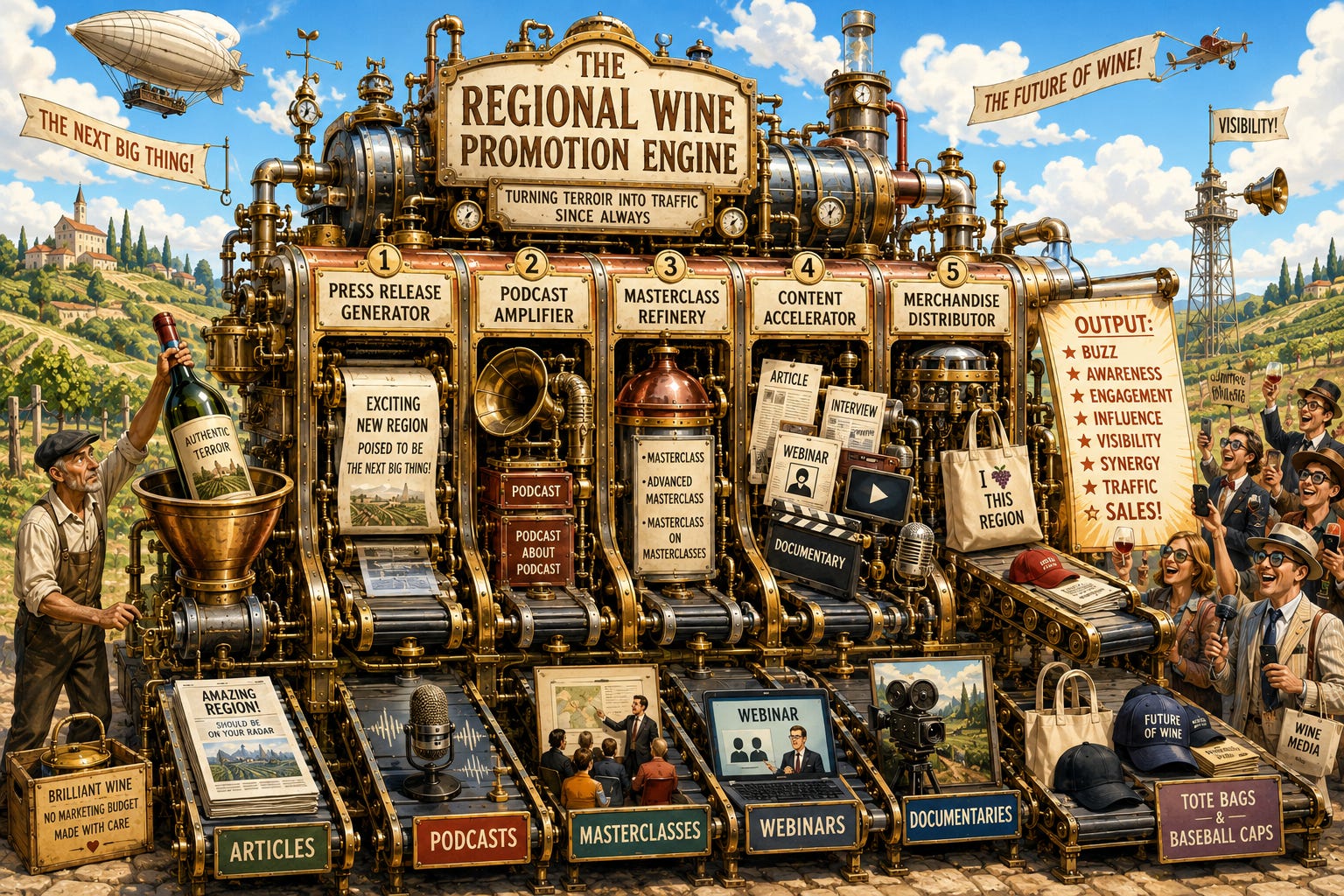
Every few months a region mysteriously becomes impossible to avoid.
Suddenly there are articles.
Podcasts.
Masterclasses.
Podcasts on Masterclasses.
Masterclasses on Podcasts.
Special reports.
Interviews.
Webinars.
Documentaries…
…and commemorative tote bags.
…and baseball caps.
One assumes this is entirely spontaneous.
Meanwhile, genuinely brilliant wines made by producers without marketing budgets often disappear into the background noise.
Now, do I think every critic is corrupt?
Absolutely not.
Do I think every critic is influenced by the environment around them?
Of course.
We’re all human.
Give somebody enough free wine and eventually they’re going to feel bad about describing it as tasting like a mutated sock hiding in a cedar chest.
Me?
Nobody sends me samples.
Nobody invites me on trips.
Nobody offers me consultancy contracts.
The last thing the wine industry gave me was a parking ticket.
But it was a limited edition one printed on very old paper.
Which is why, last Tuesday evening, I found myself wearing a maintenance vest disguise and squatting behind a luxury hotel to drink the remains of a bottle of Alexander Loersch Erdener Prälat GG Riesling.
It wasn’t glamorous.
It certainly wasn’t dignified.
But at least nobody paid me to like it.