
Building Bridges with Lia Chenetti
Wine, Language, Hospitality and Why 🍷 Might Be Enough

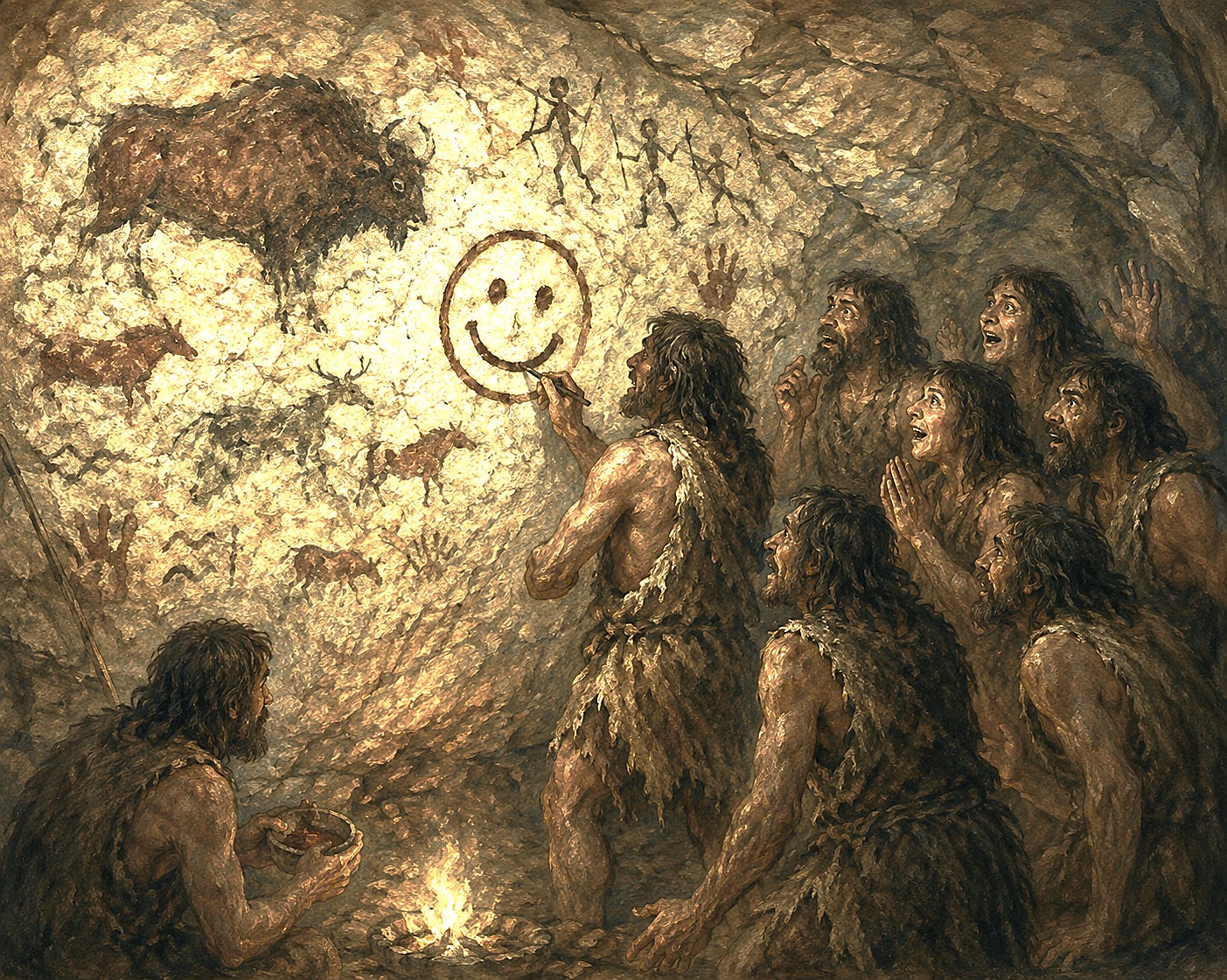
Long before humanity invented tasting notes, grids, point score systems, aroma wheels, aroma charts, Instagram reels and subtle hints of graphite, somebody…let’s call them the “Oogs”…painted a bison on a cave wall.
The message was simple and the method was primitive, yet somehow it worked.
Which raises an interesting question: what exactly is language?
Most of us think language means words.
English. American. Spanish. Italian. French. Mandarin. Cantonese.
Yet language is really just a system for moving an idea from one mind to another.
Cave paintings do that, and a road sign.
A map can do that, and a mathematical equation can do it.
A smile can do that and even a wine label can.
And, according to Lia Chenetti of the Indelible Wine Stain team, so can:
🍷😊
At first glance, this may appear to be a ridiculous proposition.
At second glance, it becomes surprisingly difficult to argue with.

Before and since joining the Indelible Wine Stain team, Lia has developed something of a cult following amongst wine lovers, social media users and “vin-fluencer.”
Her reviews are famous for reducing wines that would normally require three paragraphs of tasting notes into a handful of symbols.
A recent review of Poderi e Cantine Oddero Barolo, Vigna Rionda Riserva 2010 consisted entirely of:
🍒🌹🧱⛰️⏳✨
The review received thousands of “likes” from doom-scrollers.
It also triggered a lengthy online debate regarding whether the brick emoji represented tannin, terroir, architecture, masonry or BRIX.
Naturally, we decided to investigate.
Of course, our interview was conducted entirely by text message, despite sharing the same office space at Indelible Wine Stain HQ.
The Long History of Drawing Little Symbols
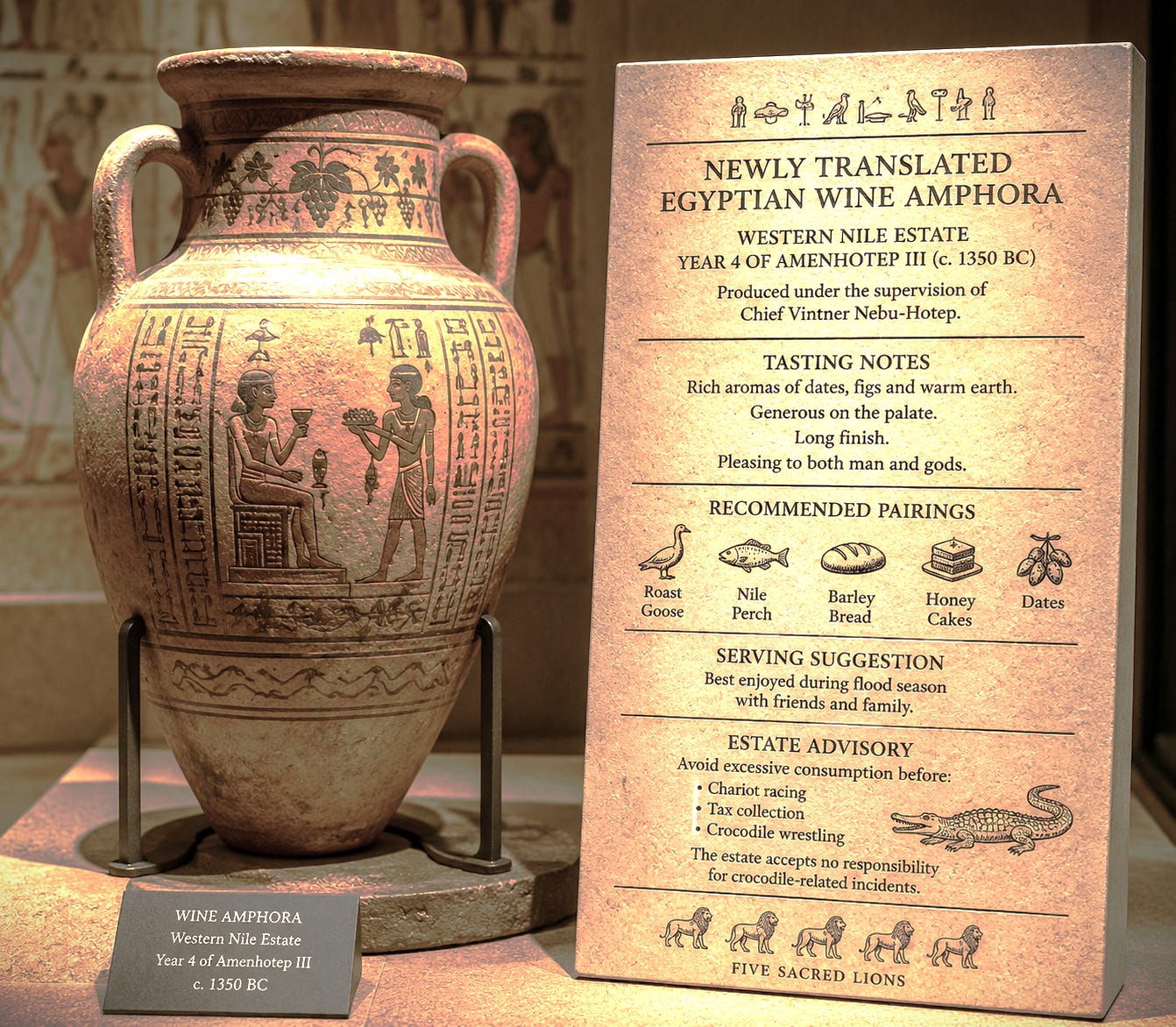
Thousands of years ago, Egyptian winemakers labelled their wine jars with information remarkably familiar to modern wine drinkers.
Usually including vintage, origin, producer and quality.
Some even included recommendations regarding what foods should accompany the wine.
One recently translated amphora appears remarkably familiar to modern readers.
“Produced under the supervision of Chief Vintner Nebu-Hotep.
Wine of excellent quality. Recommended with roast goose, Nile perch, barley bread, honey cakes and dates. Avoid excessive consumption before chariot racing, tax collection or crocodile wrestling. In fact, the estate accepts no responsibility for crocodile wrestling-related incidents.”
Three thousand years later, one suspects certain modern back labels would feel strangely at home beside it in a museum display.
Long before critics awarded scores, somebody was already trying to answer the question: “Is this wine any good?”
A few centuries later, Pliny the Elder was ranking the wines of Rome, declaring Falernian the greatest wine of his age.
For all practical purposes, Pliny may have been history’s first wine critic.
The medium was different, but the intent was identical.
Someone had tasted a wine and felt compelled to tell everyone else about it.
Two thousand years separate the Egyptian scribe and the Roman scholar.
Yet, both were attempting to solve exactly the same problem:
How do I get what’s inside my head into yours?
The Egyptians used inscriptions whilst the Chinese developed characters.
The Phoenicians developed one of the earliest alphabets.
The Greeks borrowed it and the Romans adapted it.
The Norse carved runes into stone. Medieval monks illuminated manuscripts.
Victorian gentlemen used a quill and ink to write lengthy tasting notes about Claret whilst wearing their very tall black hats.
Then, in 1999, humanity reached its highest form of communication.
The smiling face emoji.
🙂
Somewhere, a cave painter nodded approvingly.
When we suggest this theory to Lia, she responds almost immediately.
“Take the letter A. Most people assume it has always looked like that. It hasn’t. Thousands of years ago it derived from a symbol representing an ox head.”
🐂
“Over centuries it rotated, simplified, evolved and eventually became…”
A
“People think emoji appeared from nowhere,” she writes.
“They’re just the latest branch on a very old family tree.”
When Words Refuse to Sit Still
One of the strange things about language is that it never stays where you leave it. Words just drift and meanings change. Definitions of things evolve.
For example, the word awful once meant something worthy of awe.
Today it means something entirely different. That’s awesome.
The word nice once meant foolish. But today it is a compliment. That’s nice.
Language is full of these little acts of rebellion and wine is no different.
Take terroir.
Today the word often evokes vineyard expression of place. Authenticity perhaps? Yet historically, forms of the phrase goût de terroir could be used critically, suggesting rusticity or earthy characteristics that were not always considered desirable. Like a cow-pat.
Somewhere along the way, the meaning shifted but the wine did not.
The word changed.
When we ask Lia about this, another message appears.
“Language isn’t a museum,” she says knowingly, “It’s a garden.”
🌱
That may be the most sensible thing anyone has ever said using a seedling emoji.
The Problem with the Guardians and Gatekeepers
This is where things become interesting.
Lia is not against wine language. Far from it. She loves wine language.
📚❤️
She loves wine books, wine history, wine education, sensory science, the Aroma Wheels and Tasting Spokes. The problem, she argues, is not knowledge. It is the lack of context.
“Why emoji?” we ask Lia.
“Because most people don’t drink wine using words,” she reveals.
“Words, sounds, a happy dance after tasting, they all come later.”
At first this sounds absurd but then, on reflection, she may have a point.
Most people do experience wine emotionally, sometimes spiritually even, before they experience it intellectually.
A wine can feel:
😊 😌 🤩 🥰
long before anybody reaches for a tasting grid.
“Wine language becomes a problem when it becomes more important than wine communication.”
The Translator
Hospitality, she argues, is translation.
If she is speaking to her grandmother, she uses one language.
If she is speaking to a Master of Wine, she uses another.
Same wine but a different audience.
“The responsibility belongs to me, the communicator and not them. As long as they are listening of course!”
Many industries produce Guardians. The people who preserve language and protect the terminology. Defenders of precision - the Larry Davids of the world. Wine needs those people because without them, much of the history, culture and understanding surrounding wine would disappear.
But wine also needs Translators.
Those people willing to cross the bridge and meet others where they stand.
As Lia sees it, hospitality has less to do with teaching people a language and more to do with helping them understand one.
This is where her distinction between Guardians and Translators emerges.
“What is a Guardian?” we ask. Her reply arrives immediately.
🚪🔒📚😠
“And a Translator?”
🌉😊🤝😊
For readers unfamiliar with her language of emoji, we believe Lia is suggesting that Guardians build gates while Translators build bridges.
She leaves us with something to think about…
“Most tasting notes are really memory notes, nobody smells cherry.
They smell something that reminds them of cherry. There are no violets, the wine reminds us of violets. It enters through the senses, but description enters through memory and leaves through language.
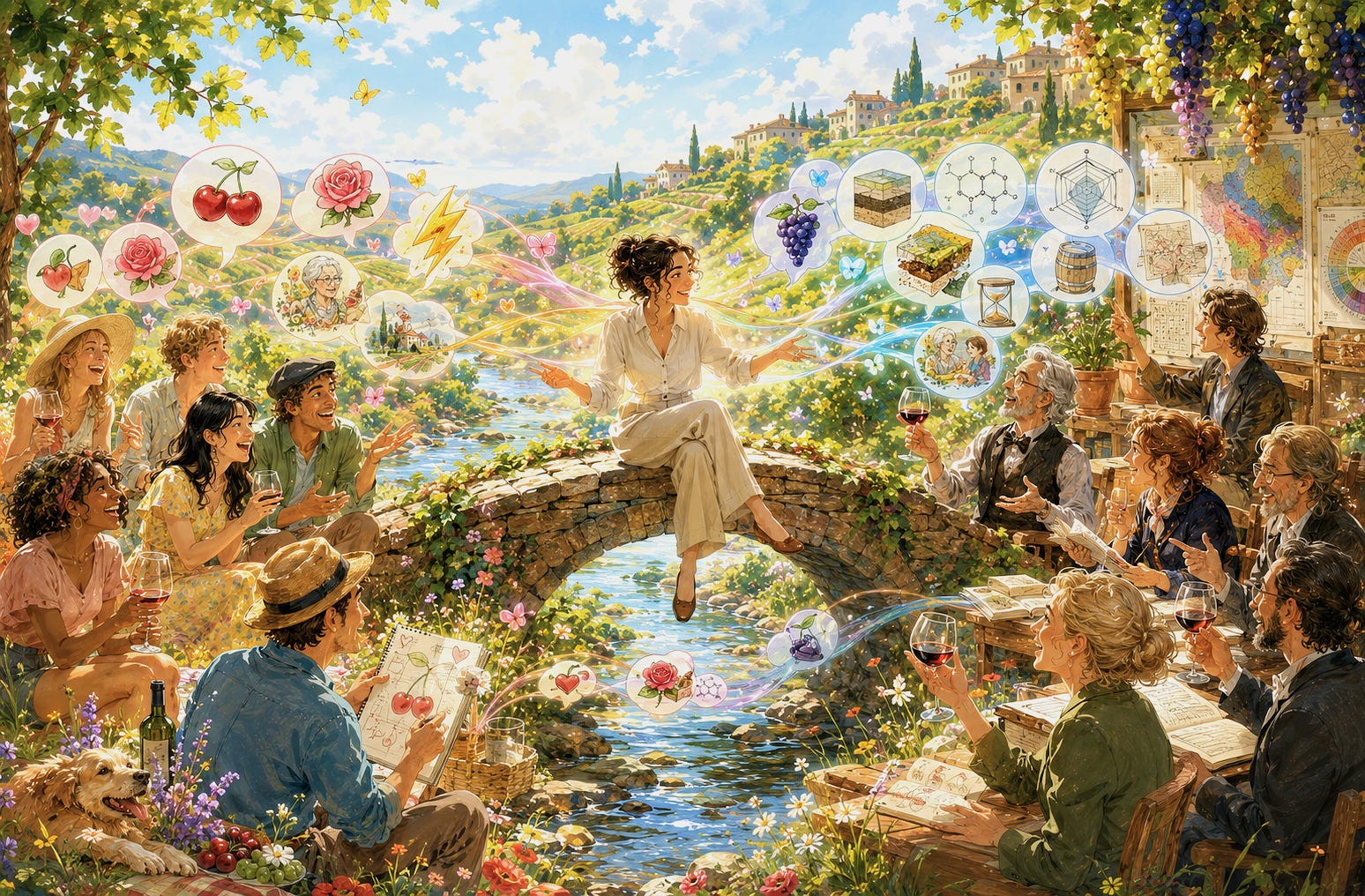
“That is why two people can describe the same wine differently and both can be right. In many ways, wine communication is simply the process of translating memories.”
Which, admittedly, sounds far less impressive when reduced to emoji.