
Don’t Poo-Poo the Poo-Poo
Reflecting on the Birds, the Berries and the True Origin of Fine Wine

Greetings Winestainers… Gregory S. Prindle here.
There may be many explanations for the greatness of wine… or not.
Some people speak of terroir. Some cannot pronounce it.
Others insist it is climate, geology, culture, or the thoughtful patience of winemakers who have learned to listen carefully to their vineyards while pretending not to interfere with them.
None of these explanations are not entirely wrong.
But they may not be un-entirely incomplete either.
Because there may, or may not, exist a player in the theatre of wine whose role in the play, at the theatre, is seldom acknowledged in tasting notes, vineyard reports, points reviews, polite dinner conversations or the theatre.
The bird.
And bird is the word.
Although we have also been told that “grease is the word” and “mum’s the word” as well.
Perhaps the word is “a greasy mum-bird.”
More precisely, we are not entirely talking about the bird.
We are talking about the bird’s digestive system.

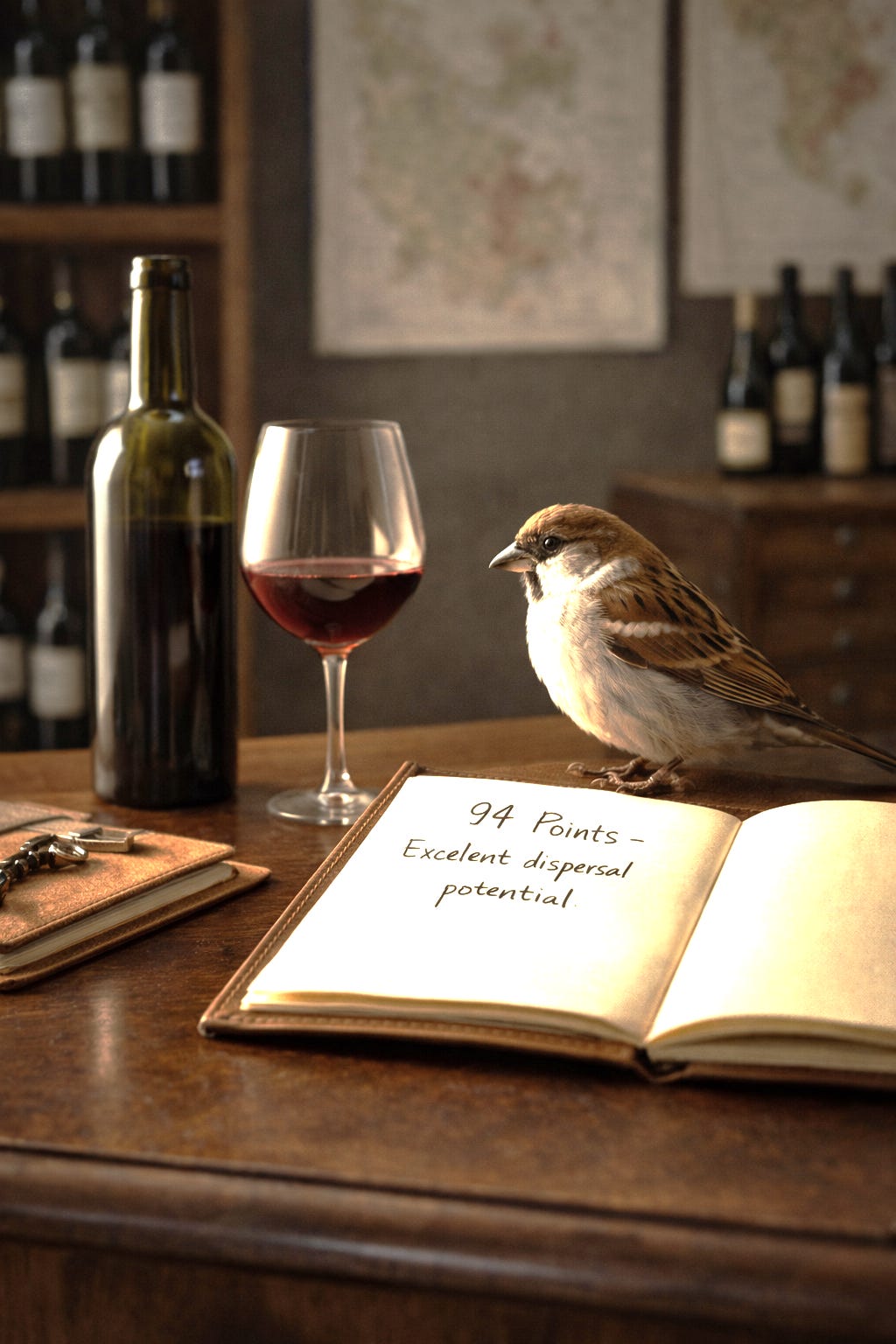
It is a matter of ecological record that many plants evolved fruit not as an aesthetic gesture toward humanity but as a strategy for persuading animals to transport their seeds elsewhere.
Biologists refer to this process as endozoochory, which is a word that is difficult to pronounce, difficult to remember, and yet somehow sounds authoritative.
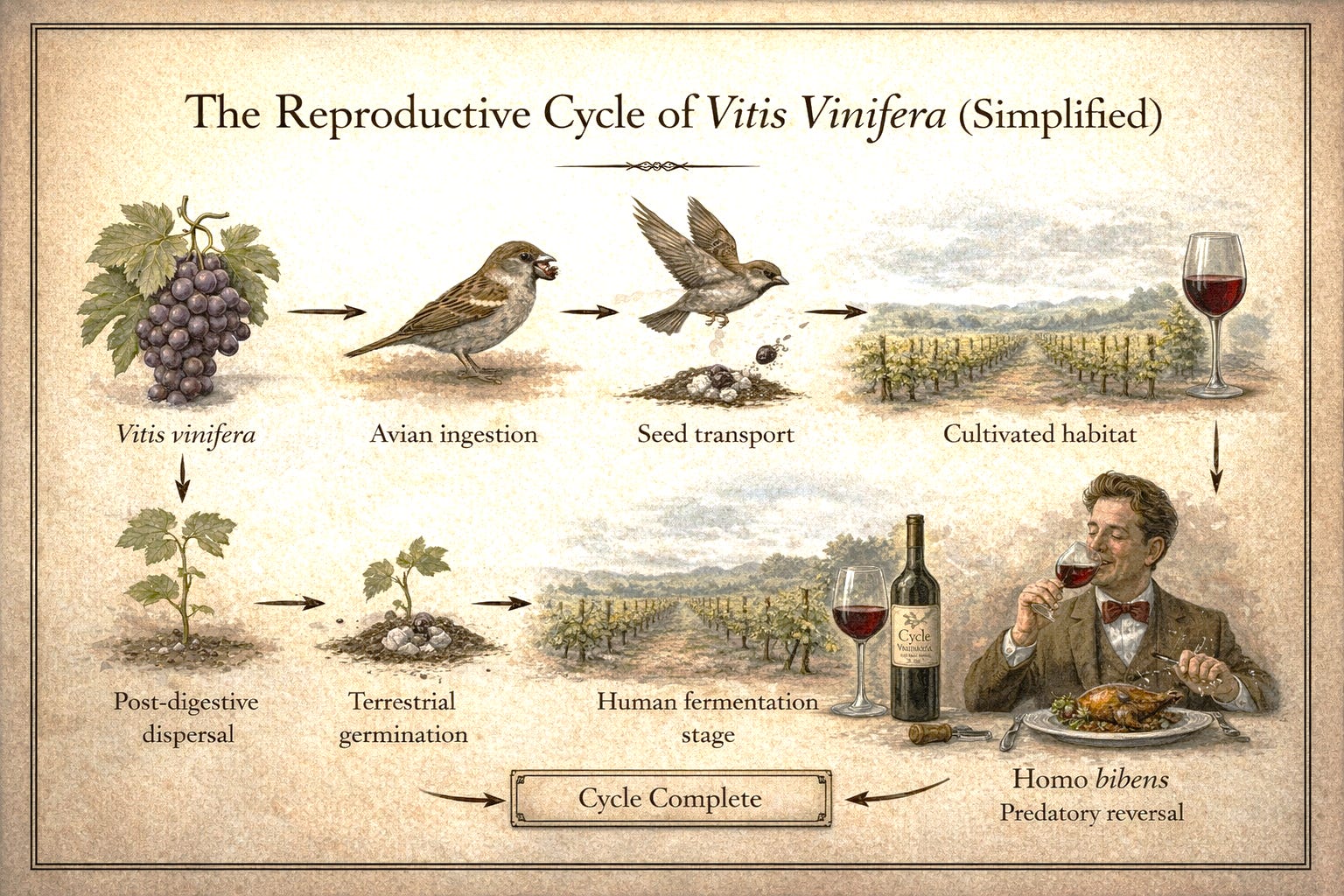
The system is elegantly simple:
The vine produces fruit containing a seed.
The fruit ripens and becomes sweet.
An animal is attracted to the fruit and greedily gobbles it down.
The seed survives the maze of digestion inside said animal.
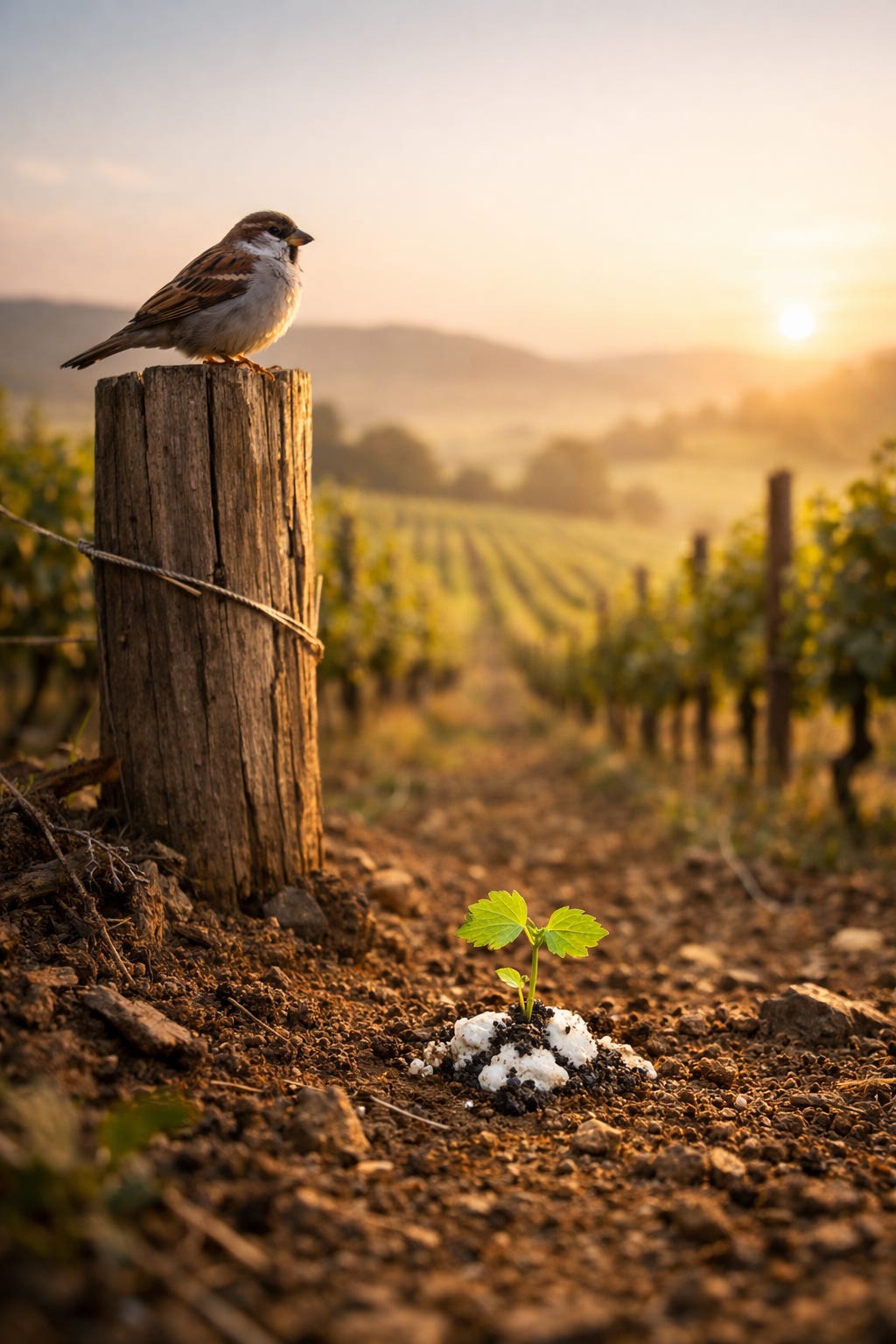
The seed arrives somewhere new… via bird poop.
The vine spreads and propagates.
So, you see, before there were vineyards, before there were appellations, and before there were sommeliers explaining minerality to confused guests, the grape berry had already perfected a method for expanding its territory.
It merely required a bird.
The Chemistry of Survival
Plants do not make flavor for our gastronomic benefit.
They actually make chemistry for their own survival.
Many aromatic compounds in grapes originate as protective molecules designed to shield the berry from sunlight, microbes, and other environmental inconveniences.
Floral aromas, for instance, often arise from terpenes.
These are compounds such as geraniol and nerol, which help protect plant tissues from ultraviolet radiation.
To the vine these molecules function as chemical sunscreen.
To the wine drinker they smell like rose petals.
Similarly, some of the most intriguing aromas in wine arise from norisoprenoids. These molecules form when carotenoid pigments, which help manage light during photosynthesis, break down during ripening.
These compounds produce elegant notes that might remind us of dried flowers, tea leaf, and certain spices.
Unless, of course, you have never been exposed to dried flowers, tea leaf, or certain spices.
In that case, they will remind you of nothing at all.
The vine itself intended none of this as palate-poetry.
It was merely protecting itself from the sun.
When the Vine Struggles
A peculiarity of viticulture is that vines growing in difficult places often produce the most interesting wines.
Strong sunlight, altitude, wind, and poor soils stimulate vines to produce greater concentrations of protective compounds in their skins.
The vine will do almost anything to protect the seed…like any good parent.
Some of these strategies include:
Developing phenolics, which strengthen the berry
Producing tannins, which discourage predators by being bitter
Creating pigments, which shield tissues from radiation
In practical terms, when the vine works harder to survive, the wine can become more complex.
Rather like a contestant on the television program Survivor.
Or perhaps even more accurately like a contestant on Squid Game.
The plant physiologist might call this adaptive stress chemistry.
The winemaker or wine lover might simply call it terroir.
It is not entirely unclear that the vine does not care what we call it.
Case Studies
Let us look briefly at some wines that illustrate these ideas.
Dirupi - Valtellina Superiore, Lombardy, Italy 2017
Produced from Nebbiolo grown on steep terraces in the Italian Alps.
When tasting, our team noted memories of rose petals, some herbs of some sort (this caused a long argument), and sour cherries.
These aromas originate largely from terpenes and norisoprenoids concentrated in the grape skins, stimulated by high ultraviolet exposure in mountain vineyards.
The vine produces these compounds to protect its tissues from radiation.
The resulting fragrance and taste are admired by sommeliers and wine lovers.
However, we suspect the birds noticed it first.
Hirsch Vineyards - Raschen Ridge, Pinot Noir, Sonoma Coast 2019
High above the Pacific Ocean sits “Raschen Ridge Vineyard,” farmed by Jasmine Hirsch and her excellent team.
Here Pinot Noir vines endure fog, wind, and persistent sunlight.
In response the grapes develop thicker skins rich in phenolic compounds, which help defend the berry against environmental stress.
These molecules later contribute the lifted aromas of cranberries, freshly purchased roses, and supermarket soft spices.
The vine calls this survival.
Wine lovers call it complexity and elegance.
Zuccardi - Alluvial Malbec, Gualtallary, Mendoza, Argentina 2019
At more than 1,400m elevation in the Uco Valley, vineyards sit among ancient alluvial fans beneath the Andes.
Under intense sunlight and cold nights the vine produces thick skins rich in phenolics and aromatic precursors.
These compounds protect the grape from ultraviolet radiation and oxidative damage.
The resulting Malbec shows remarkable structure and clarity.
Winemakers speak beautifully of limestone and geology.
The vine, less philosophically inclined, is responding to sunlight.
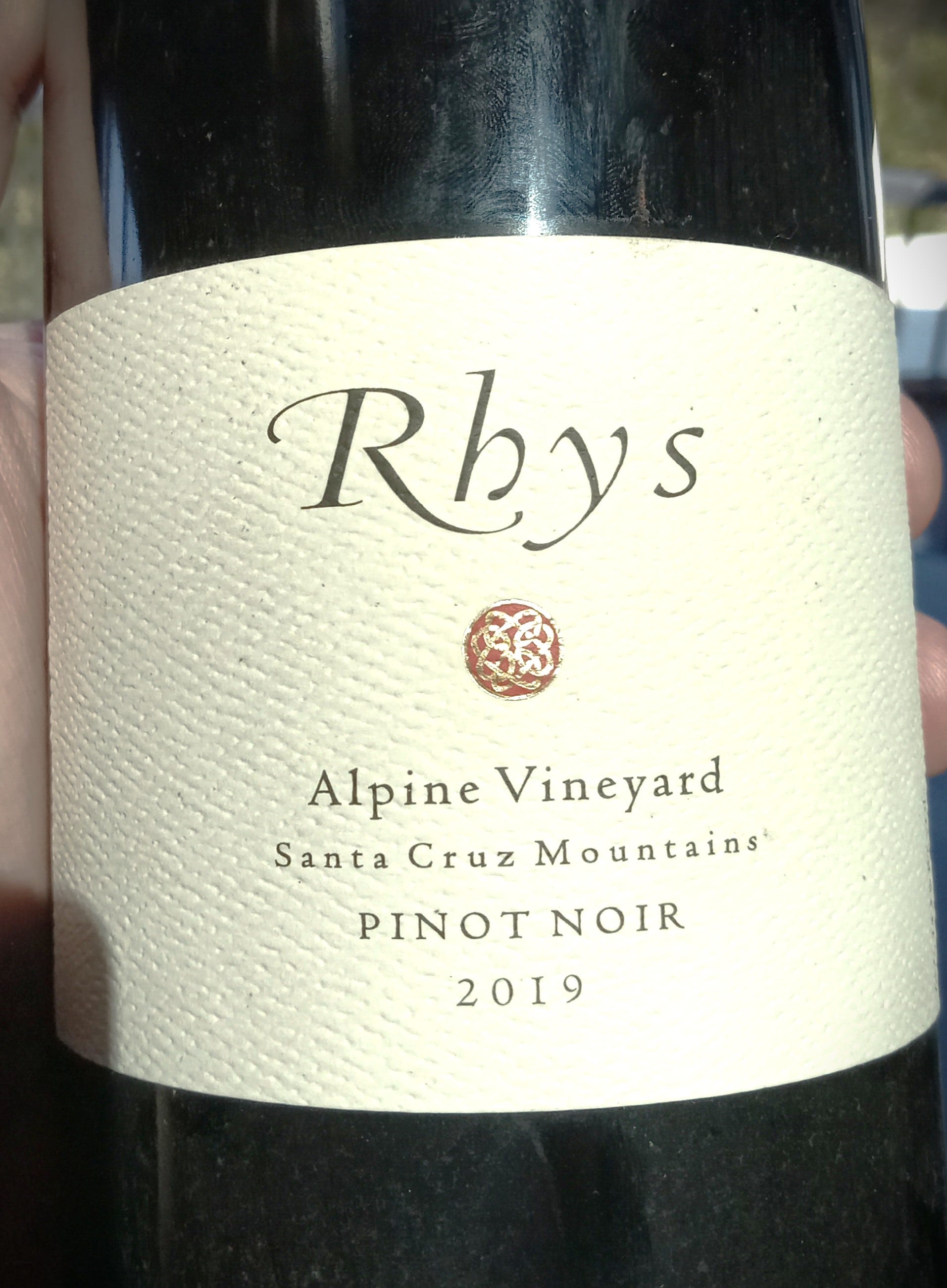
Rhys - Alpine Vineyard Pinot Noir, Santa Cruz Mountains 2019
In California’s Santa Cruz Mountains the dramatic Alpine Vineyard produces Pinot Noir of remarkable precision.
The 2019 vintage expresses slow ripening conditions created by fog, altitude, and sunlight.
These conditions encourage the formation of aromatic precursors and phenolic compounds in the grape skins.
In the finished wine these molecules translate into what we call in winespeak:
“Red fruit, herbaliness, and subtle spice.”
The vine was merely protecting the seed.
The wine world calls it complexity.
Ciel du Cheval - Cabernet Franc, Red Mountain, WA 2014
The vineyards of Red Mountain receive some of the most intense sunlight in Washington State.
At the historic Ciel du Cheval Vineyard, Richard Holmes leads the team.
(The Holmes family, naturally good at deductive reasoning, once attempted to trace their ancestry to Sherlock, but this proved inconclusive.)
Cabernet Franc vines grow in sandy soils exposed to heat and wind.
Under these conditions grapes accumulate proanthocyanidins, tannins formed in skins and seeds that deter predators and pathogens.
In the finished wine they create the firm structure collectors admire.
What once discouraged animals now encourages wine sales.
Ayunta - Calderara Sottana Nerello Mascalese, Sicily, Italy 2021
On the northern slopes of Mount Etna lies the celebrated contrada Calderara Sottana, where Ayunta farms old Nerello Mascalese vines.
At elevations around 700–800m, vines grow in porous basaltic soils that drain quickly and encourage moderate water stress.
In response the grapes develop thick skins rich in phenolic compounds and aromatic precursors.
The resulting wine reminds us of sour cherry, another herbal tasting room disagreement, and a subtle mineral austerity.
Humans describe the wine as volcanic.
The vine would probably describe it as practical.
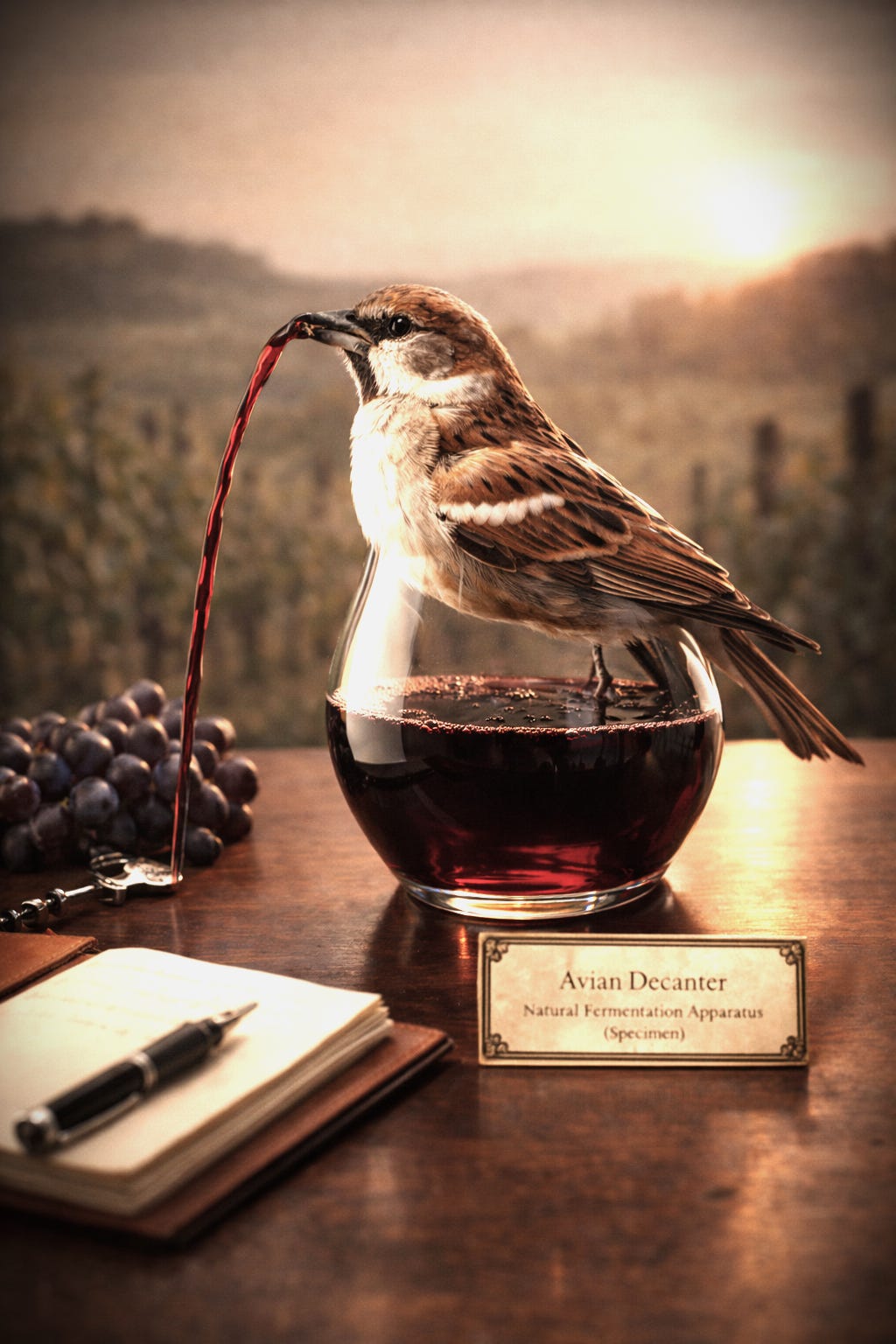
A Brief Word About Bird Decanting
Wine lovers often speak of decanting; allowing oxygen to interact with wine so that aromas may develop more fully.
It would be irresponsible to suggest that the digestive system of a bird performs a similar function.
Is the bird nature’s decanter?
No, it isn’t.
And it would be unethical to try.
Final Thoughts from the Prindle
So, as you can see, when the chemistry of grapes and the ecology of fruiting plants are examined together, one conclusion becomes increasingly difficult not to consider.
Many of the compounds that make great wine fascinating (tannins, aromas, pigments) evolved not for human pleasure but for plant survival.
The vine protects the seed.
The grape attracts animals.
And occasionally those animals carry the seed somewhere new via plop.
This may not entirely diminish the romance of wine, although it may slightly complicate it.
After all, a Grand Cru vineyard may be the result of centuries of careful farming, thoughtful winemaking, and the tireless work of generations of growers.
But it may also be the indirect consequence of a bird with good aim and a functioning digestive system.
Which is not to say that great wine is bird droppings.
But it would be equally incorrect to say that bird droppings have had nothing to do with great wine.
So remember, Winestainers:
do not dismiss the biological foundations of the vine.
And for that reason alone, it must be said, calmly and without prejudice…
“don’t poo-poo the poo-poo.”