
Windy Thoughts from the Windy City
Sent in by Tommy Cribbleston III of Elm Park, Upper West South Side, Chicago

Well, “Toot, Toot, Toot, Dr. Winestain,”
I have to say that I have been following you for some time and finally I’ve got the courage to ask a question. I would have knocked on your door at 42 Coronation Road, Apartment 3, in Hastings but I feel that writing a letter into the Indelible Wine Stain is more fitting.
So, I am proudly and passionately a wine lover. Not just a casual sipper, mind but a fully-fledged, cork-sniffer. I find wine to be among the greatest cultural achievements of humanity, like language, the wheel and double-ply, wine education themed toilet roll. Every bottle is a story, every soil a poem. Although not a rhyming poem, instead one of those ones that don’t rhyme on each line, all the time.
But here is the rub…I also love prunes, beans and really anything fibrous.
I eat healthfully and abundantly. My digestion, shall we say…expresses itself.
I am, to put it bluntly, a “Man of Wind”.
Not the metaphorical kind that billows sails and animates the trees but the very real, tangible, audible, smellable kind. The kind that that will recoil a refuse collector and push loved ones to evacuate the plane without parachute.
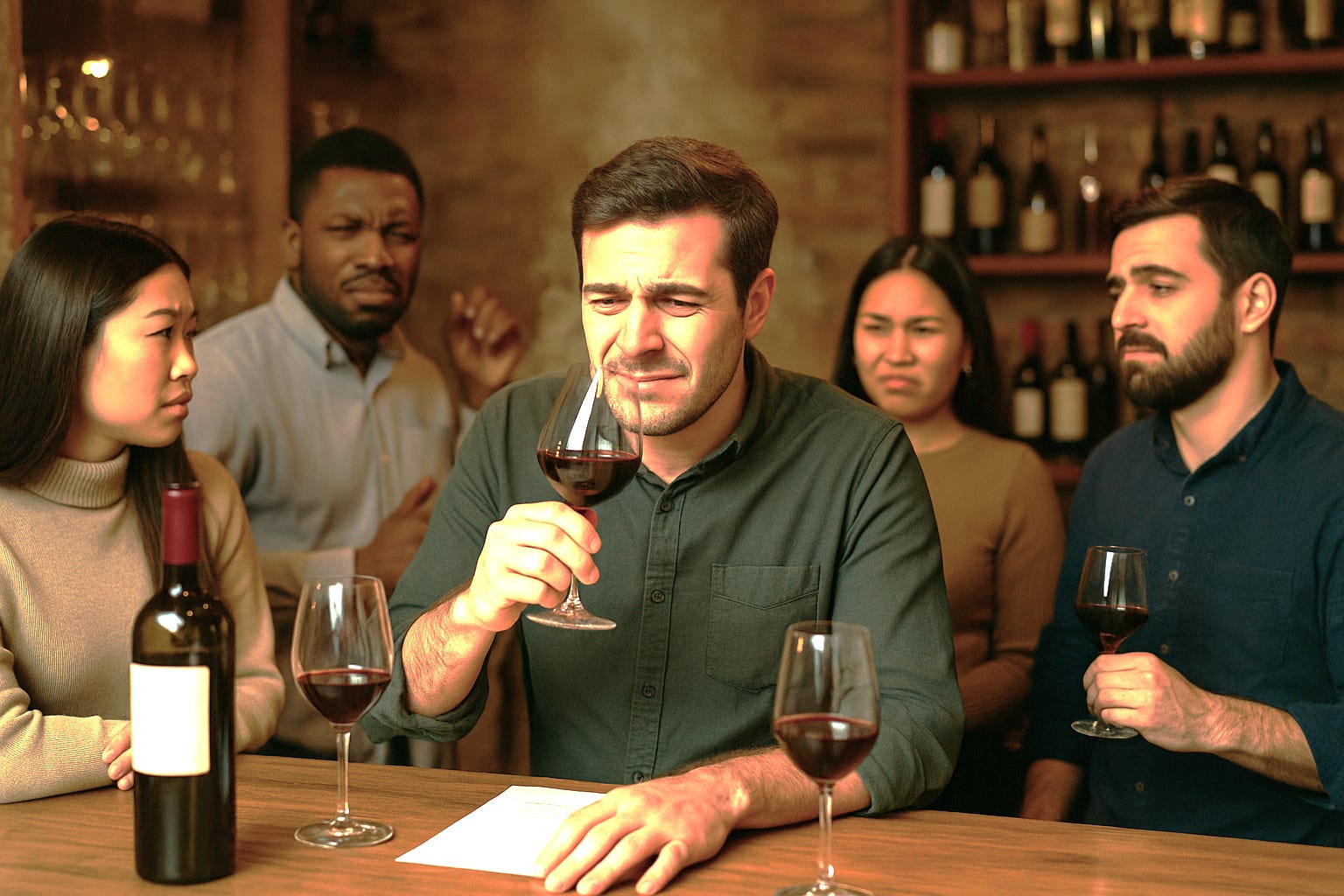
Yet as I sat the other day, alone, politely distancing myself from friends and sipping a glass of the fantastic Terre Rouge, “Ascent,” Syrah 2009, I had a revelation. A connection, if you will.
As I pondered my own “jetstream,” I remembered reading about the Mistral wind in the Rhône Valley. They wrote of a blustery northern gale that shapes the spirit of Grenache and Syrah. And suddenly I wondered:
“Am I, in my windiness, somehow connected to the vine?
Do grapes, too, know the curse of wind? Do these wines understand me?
Do they suffer wind as I do, and emerge stronger for it?
Sorry for gassing on,
Tommy Cribbleston III

Dr Winestain: I’m not sure whether to answer the question or get a stalking protection order put in place but never-the-less, what a great query!
The long and short of it is that yes, wind is absolutely one of the unsung heroes of great viticulture. Also, remember nothing is gassier than a fermentation. Let’s break wind together. I mean, break down wind together.
Wind. Natures natural air drier. It cools, it dries, it punishes, it purifies.
It helps to regulate vine temperature, prevent the mildew, reduce the rot and it thickens the grape skin and let’s face it, we all need thick skins in this modern world. Which is why I always wear a Puffer Jacket, even in bed.
Why Thicker Skins Matter for Wine
Thick-skinned grapes offer a higher concentration of phenolic compounds. That is to say, tannins, anthocyanins (color pigments) and aromatic precursors. This results in deeper color, firmer structure and greater aging potential in the resulting wine. It’s why many of the world’s boldest, most characterful reds come from windy, stressful environments…from Domaine Duclaux in the Rhône to Luis Pato Baga in Bairrada.
Let’s clear the air here, Cribbleston.
Have you ever looked at a grape and thought to yourself, “Blimey O’Riley, this smells like nothing…but I’ve heard it can turn into an amazing befuddling perfume in the bottle?”
Well, that dear Sir, is the magic of aromatic precursors.
What on earth is an aromatic precursor?
Imagine a grape as one of those scented hand lotions your Aunt Betsy buys in bulk. The overwhelming smells of lavender, jasmine, grapefruit and, occasionally, “Forest Pine.” But the cap is on. Tight as can be. You can’t open it as you damaged your hand playing darts. It’s your darts arm.
We lay frustrated, as all those aromas are in there, but they are sealed up tighter than a Seal in a leotard. Unless it opens, it is aroma-less.

Then along comes fermentation, the yeasts arrive, and those dormant aromas have a chance to escape. So, the thicker the skins, the more potential aromas.
Just as grapes have hidden aromatic potential, so too, unfortunately, do your bowels. Farts are after all a form of fermentation. Yes, your guts are essentially low-budget wineries, where rogue bacteria munch on undigested carbs and unleash volatile aromatic compounds such as:
Hydrogen sulfide (rotten eggs)
Methanethiol (burnt cabbages)
Indole & skatole (barnyard, and I don’t mean the terroir kind, actual barnyard)
Ammonia (that smell that clears a room and ends relationships)
These weren’t aromatic inside you. But when released…evacuate immediately!
It’s fermentation. It’s volatile. It’s natural. It’s horrifying.
You and the grape, my friend, are not so different.
And now for the moment you have all been waiting for…
Dr. Winestain’s Top Ten Wine Winds of the World
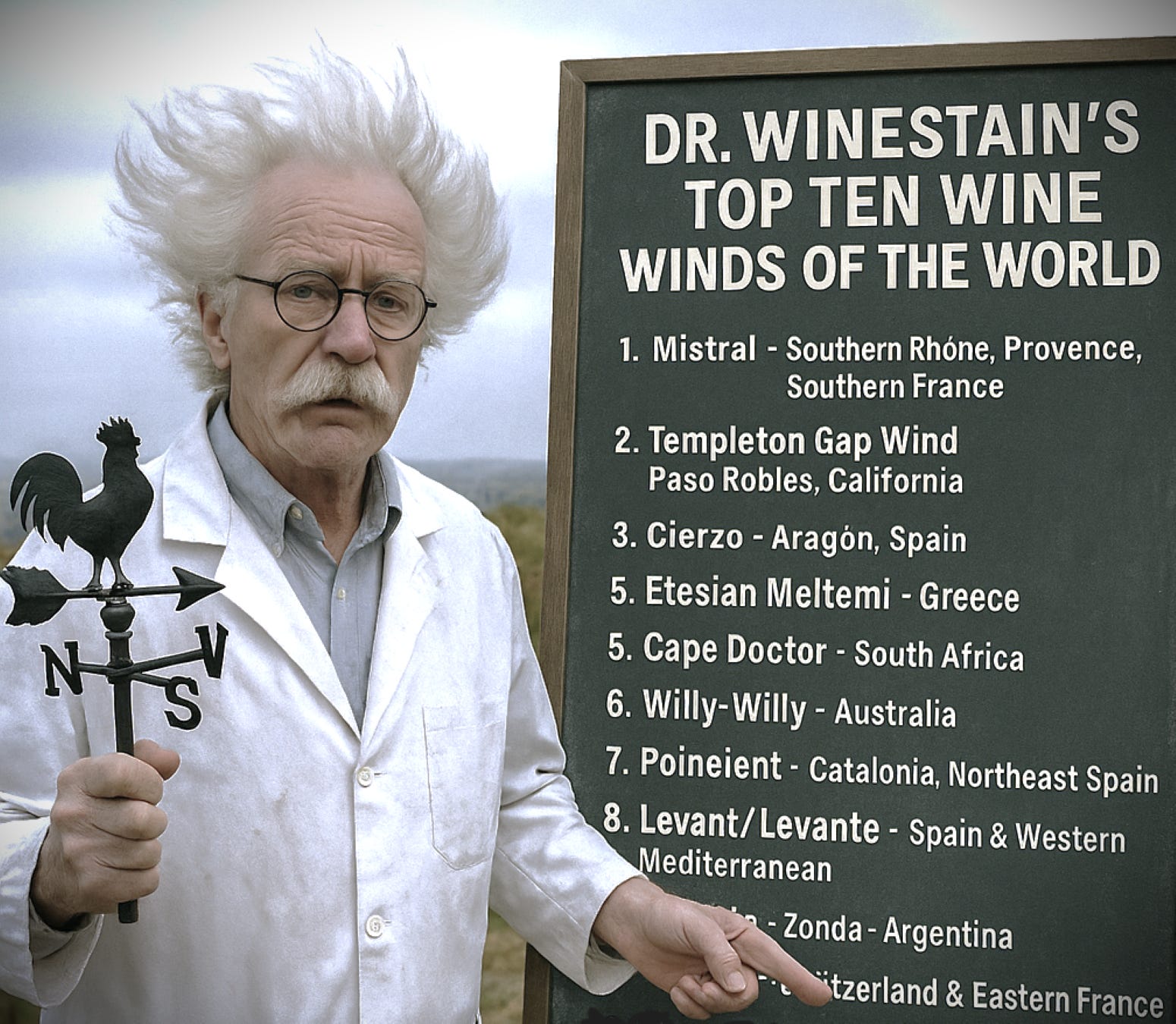
Coming in strong at #10 - La Bise
Origin: Switzerland, blowing in from the Northeast.
Meaning: From old French/Germanic roots meaning “to blow.”
Character: Cold and crisp.
Wine Regions Influenced: Geneva, Vaud, Jura, Savoie and the edges of Northern Rhône.
Impact: Dries out mildew and thickens skins. Also preserves acidity, keeping the wines crisp and crunchy!
Down two places from last year to #9 - the Zonda from Argentina
Origin: A foehn wind cascading down the Andes into Mendoza.
Meaning: A Quechua (indigenous) word for “blow” or “bluster.”
Character: Warm, dry and dramatic.
Wine Regions Influenced: Mendoza, San Juan and La Rioja.
Impact: Evaporates mildew and thickens grape skins.
Note: A Foehn wind is a warm, dry wind that rushes down mountains, drying out vineyards and boosting grape ripeness like nature’s bathroom hand dryer.
A new chart entry at #8 - Levante in Spain & Western Mediterranean
Origin: Humid easterly wind from the Mediterranean that crashes into Iberia.
Meaning: Translates to: “the place where the sun rises.”
Character: Moist and moody (like my mood in August).
Wine Regions Influenced: Andalusia (Jerez), Valencia and Roussillon.
Impact: Vital for the nurturing of Flor yeast in Sherry.
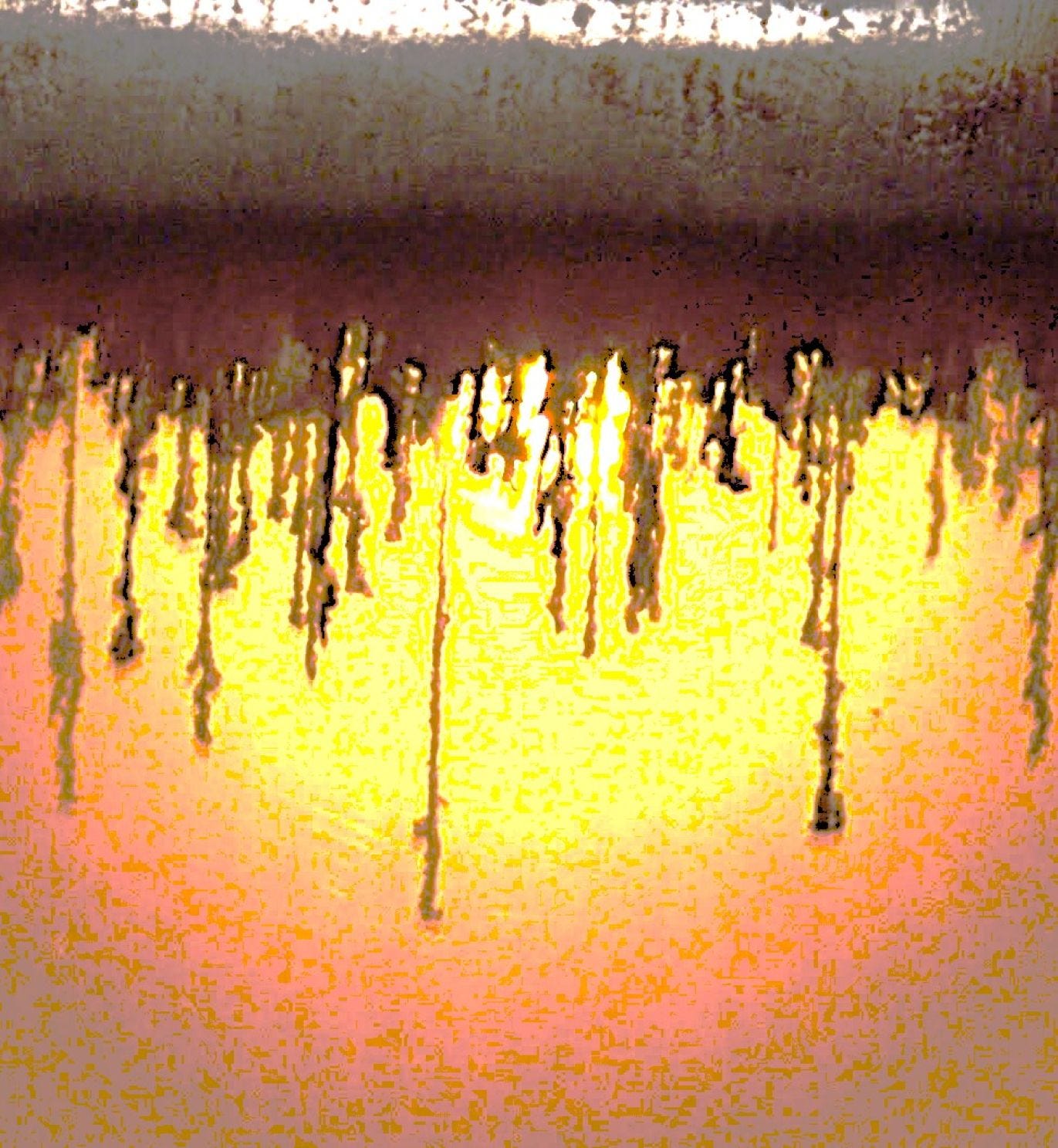
Is it an image of Flor developing or something more sinister?
That’s right kids, don’t forget to brush your teeth.
Back on the list at #7 - Poineient/Tramontana of Catalonia
Origin: Northern gusts that rush down from the Pyrenees.
Meaning: From the Latin” “Transmontanus,” beyond the mountains…
Character: Sharp and clean like a fresh pencil.
Wine Regions Influenced: Empordà, Penedès and Roussillon.
Impact: Cools and dries the vineyards, reducing risk of humidity.
At #6 is the amazingly named Willy-Willy of Australia
Origin: Small but powerful Whirlwinds in more arid regions.
Meaning: Indigenous Aboriginal term for “Dust Devil.”
Character: Chaotic and unpredictable mini-cyclones.
Wine Regions Influenced: Western Australia and inland Southern Australia.
Impact: Usually short-lived but stirs up airflow and great for ventilation.
On call at #5 is the Cape Doctor of South Africa
Origin: Southeasterly from off the Indian Ocean
Meaning: Locals would say that the Doctor “cures” the Cape of all ills.
Character: Strong and relentless
Wine Regions Influenced: Stellenbosch, Constantia, Cape Town & Walker Bay
Impact: Blows off disease, cools grapes and thickens skins
At #4 - a summer banger since 500 BC - Etesian/Meltemi in Greece
Origin: A northern wind from the Balkans that falls over the Aegean Sea.
Meaning: Translates to, “Annual Winds” in Greek.
Character: Dry, cooling and sometimes aggressive like an Angry fan.
Wine Regions Influenced: Cyclades (Santorini), Crete and mainland Greece.
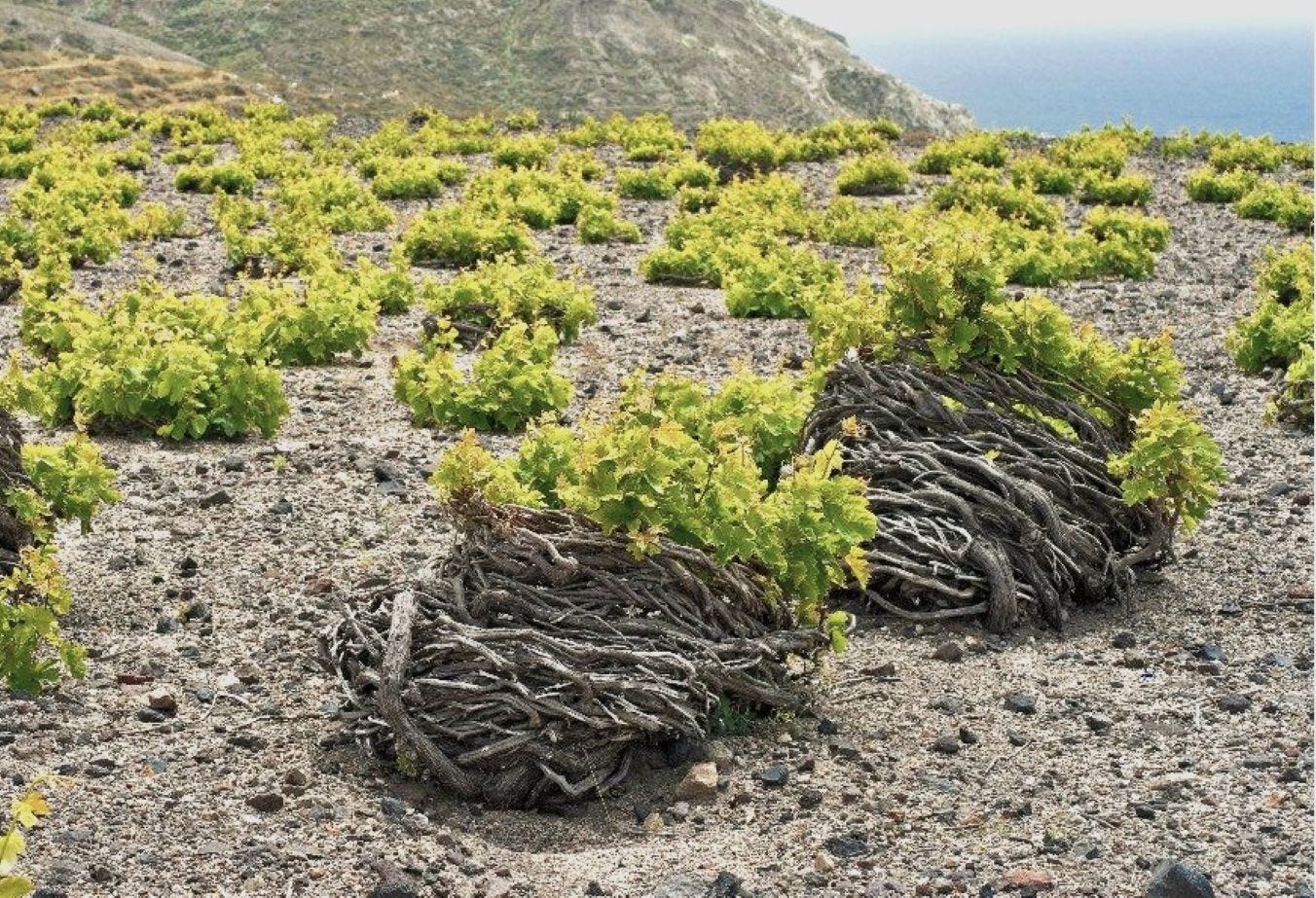
Impact: Has led to the development of the grape, Assyrtiko to have Kouloura-trained vines (the famous basket weaved style of trellising).
Staying solid at #3 is the Van Duzer Corridor wind of Oregon
Origin: Cool Pacific Ocean air funneled through a coastal gap.
Meaning: Named after Henry B. Van Duzer, a prominent local Lumberman.
Character: Brisk, cooling, powerful and punctual.
Wine Regions Influenced: Eola-Amity Hills and Willamette Valley in general.
Impact: Great for Pinot Noir, slowing down ripening and developing flavor.
Brand new at #2 - the Templeton Gap Wind of Paso Robles, California
Origin: Another Pacific Ocean coastal range gap.
Meaning: Named after the town of Templeton, just as Faceman in the A-Team.
Character: As hot inland air rises, the cool marine air is sucked eastward through the Gap - temperatures drop dramatically in the evening.
Wine Regions Influenced: Paso Robles AVA (Willow Creek & Adelaida districts)
Impact: The evening drop in temperature allows the grapes to fully ripen whilst retaining freshness - extending what is called a diurnal shift.
And now, at Number One - the Rebel of the Rhône,
the Powerhouse of Provence,
the Gale that Never Fails,
the Whirlwind Winner of the Wine World Wind Award...
…It’s the one and only
Mistral!

#1 - the Mistral
Origin: Coming from the Alps and heading at speed to the Mediterranean Sea.
Meaning: In Occitan, it means “masterly.”
Character: Cold, fast and legendary at upwards of 100km per hour.
Wine Regions Influenced: Southern Rhône, Provence and the Languedoc.
Impact: It shapes the region’s identity.
Trellising has been adapted to meet the mighty wind with many vines trained to be low to the ground or even without a trellis (called a “gobelet.”)
Then there is the “Échalas.” A wooden stake is driven deep into the ground next to the vine so that it can be bound in a spiral or figure 8 weave, so that the vine can flex and bend to the battering Mistral rather than be snapped in two like a KitKat or really any chocolate bar that has a biscuit base.
The wind is a challenge for sure but at the same time the winegrower wants it to pass through, as it prevents fungal diseases. It is like having a helicopter hovering over the vines.
They protect themselves by developing thicker skins…giving more oomph!
Also, the acidity is preserved leading to a chance to make age-worthy wines that have balance and finesse.
I once had all of my hair stripped off my head whilst touring Côte-Rôtie.
Eyebrows and all.
So, there you have it…a long, rambling answer that you may not have needed.
Tommy…you and many of the world’s greatest vineyards do share a windy affliction. You are, in your own chaotic way, a terroir-driven expression of internal weather patterns.
Until next time, get tasting and be curious
And don’t forget to let it rip!
Have more wine queries that need uncorking?
Send them in and let Dr. Winestain ramble on about something else entirely.
send email to Dr. Wine Stain by emailing to the email address indeliblewinestain@gmail.com from your email address.