

People often ask me what my favorite wine region is.
I get it a lot as a Sommelier.
They expect Burgundy, Bordeaux or Napa Valley.
If they’re feeling adventurous, they’ll throw in the Mosel, like we are playing some sort of vinous episode of Magnus Magnusson’s Mastermind.
Truth is…I rarely answer straight away.
You see, the answer depends entirely on what I’m looking for.
Today, though, I’m looking for Muscadet and the wonderfully understated Pornic, in the Loire Atlantique.
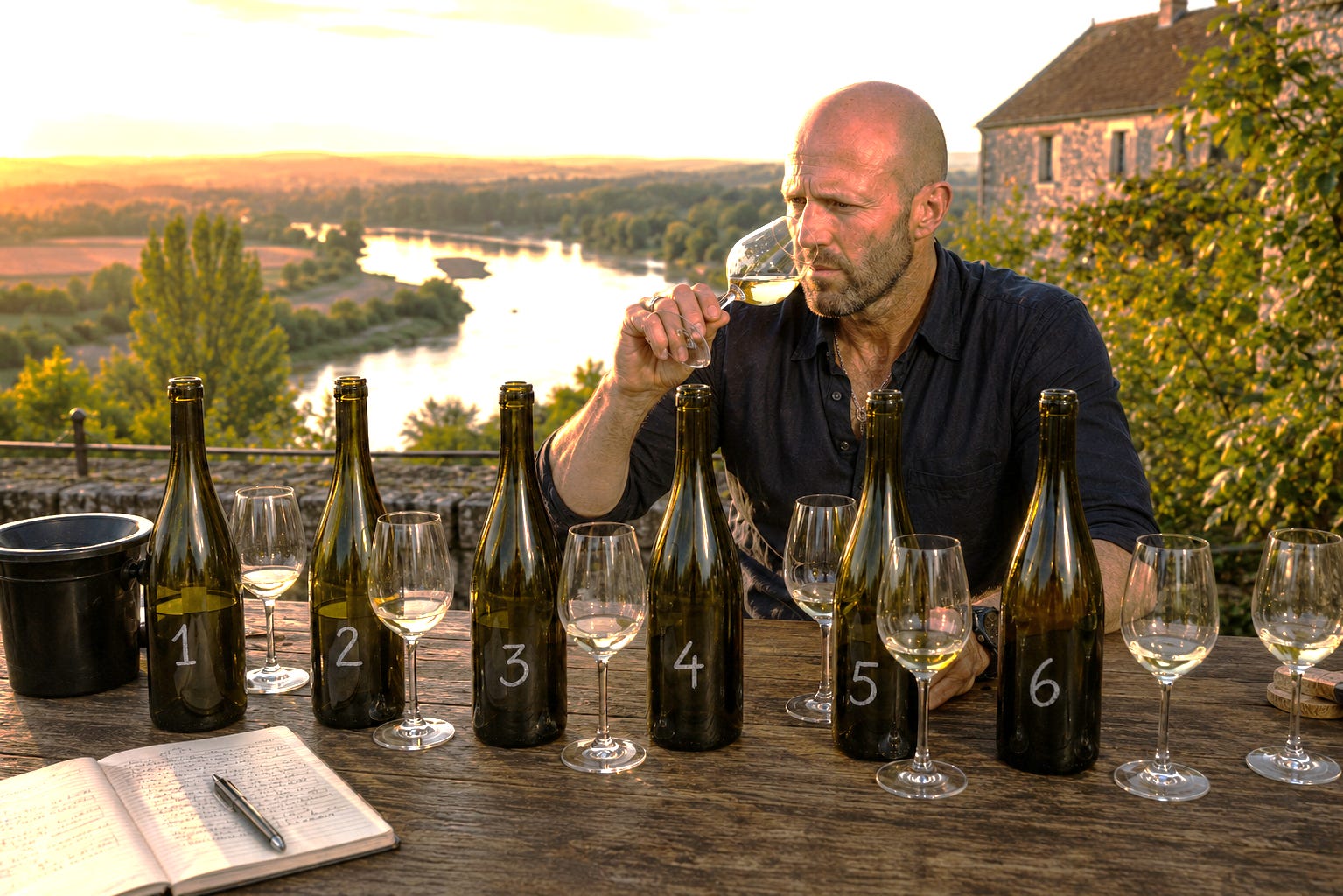
Pornic isn’t interested in any of the glitzy nonsense.
It has a working harbor with fishing boats.
Oyster beds stretching out the woozah into Bourgneuf Bay.
A medieval château watches over everything like an old East End geezer.
Seafood restaurants have chalkboard menus with today’s specials.
Which is precisely why I keep coming back.
I’ve always thought places that know they’re good rarely feel the need to tell you that.
Wine regions are much the same.
Gulls drifted overhead with the confidence of seasoned pickpockets.
The air smelt of salt, butter and shellfish. That, to me, is western Loire.
I’ve always had a soft spot for Muscadet and I was meeting a couple of local producers that evening. Lovely blokes.
“It’s funny,” I said. “Say off-dry and everyone starts imagining a bloody trifle.”
That got a laugh.
One of the producers shrugged.
“We spend half our lives explaining that dry isn’t the opposite of interesting.”
Exactly.
We found ourselves talking about Muscadet.
“I reckon most people made their minds up after drinking one cheap bottle twenty years ago.”
They nodded. “It happens.”
I took another sip. “Funny thing is...”
I was just about to say something very amusing and intellectual.
Then I stopped.
There it was.
That voice.
It wasn’t loud.
It wasn’t theatrical.
Just...immediately familiar.
Couldn’t quite put my finger on it though.
“...Good evening, ladies and gentlemen...”
I turned slowly towards the restaurant.
“...Listen. May I recommend tonight’s Muscadet...”
A pause.
“...Beautiful with oysters...”
Another pause.
“...Bone.”
“...Dry.”
I frowned. No. Surely not.
The winemakers carried on talking but I couldn’t listen anymore.
“...hold your horses...”
I looked through the restaurant window.
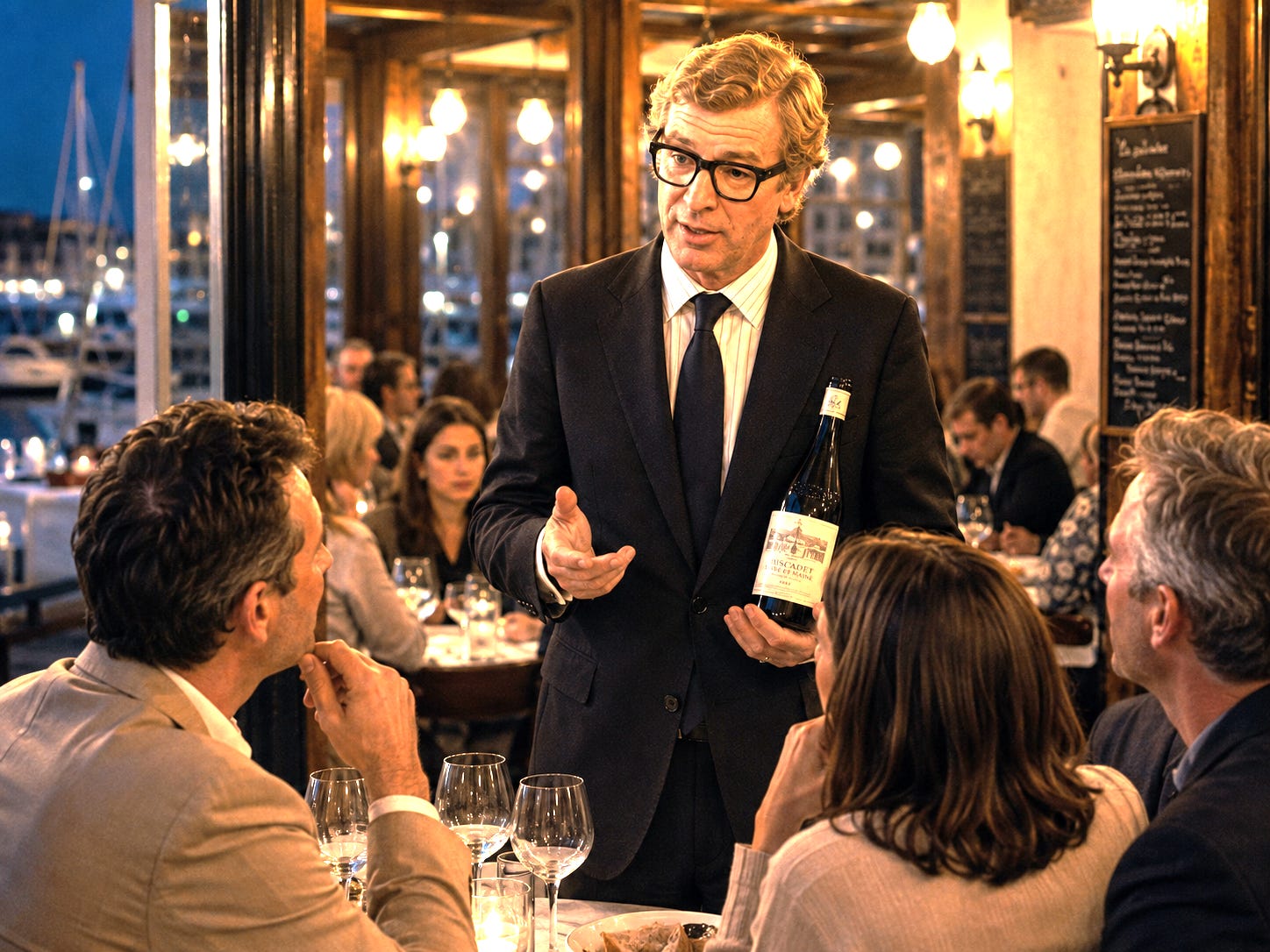
A sommelier stood beside a table, bottle in hand, talking to guests.
Dark-framed spectacles.
Thick black hair.
Dark suit.
The unmistakable profile of Michael Caine.
Not Alfred from Batman. Not the elder statesman from Inception.
Young Michael Caine.
Ipcress File Caine.
One of the producers noticed I’d disappeared into my own thoughts.
“You alright?”
I pointed silently through the glass.
“Um, yeah…well, no. I mean yeah...that’s Michael Caine!”
I left them standing on the harbor while I watched from the doorway.
The sommelier finished presenting a bottle. He poured a tasting measure. Waited. Received a nod. Then served everyone else without spilling so much as a drop. Before moving away, he wiped the neck of the bottle. Twice.
Folded the service cloth. Stepped back. Nothing theatrical. Nothing wasted.
Wallop. One-Two. Classic wine service.
Funny thing was, the longer I watched him, the less I noticed Michael Caine.
What I noticed instead was an exceptionally good sommelier.
He moved through the room with remarkable economy.
One elderly lady quietly exchanged places with her husband.
Before she’d even settled into the chair, he’d swapped the wine glasses around without anybody asking.
A waiter dropped a fork.
He had another in his hand before the first had finished bouncing.
He somehow managed to give each table exactly what it needed without ever appearing hurried.
The resemblance to Michael Caine was rapidly becoming the least interesting thing about him.
A waiter wandered over. “Table for one?”
I nodded towards the dining room. “I’m waiting for Michael Caine.”
The waiter smiled politely. “Doug will be with you shortly.”
Doug?
When every table was happy, Doug walked over carrying two glasses.
He placed them gently on the table.
“Good evening Mr. Botcher...”
The voice. Exactly the same.
“I’m sorry mate...have we met?”
He smiled politely. “I know your work.”
For one glorious second, I wondered whether he’d read Indelible Wine Stain.
Perhaps we’d met at a tasting or he’d seen a seminar.
Doug continued. “You were excellent...in The Transporter.”
I stared at him. “I’m sorry?”
We both laughed.
Then said something that would quietly shape the rest of the evening.
“Before we begin...”
A pause.
“...I’d like you to forget everything you think you know about Muscadet.”
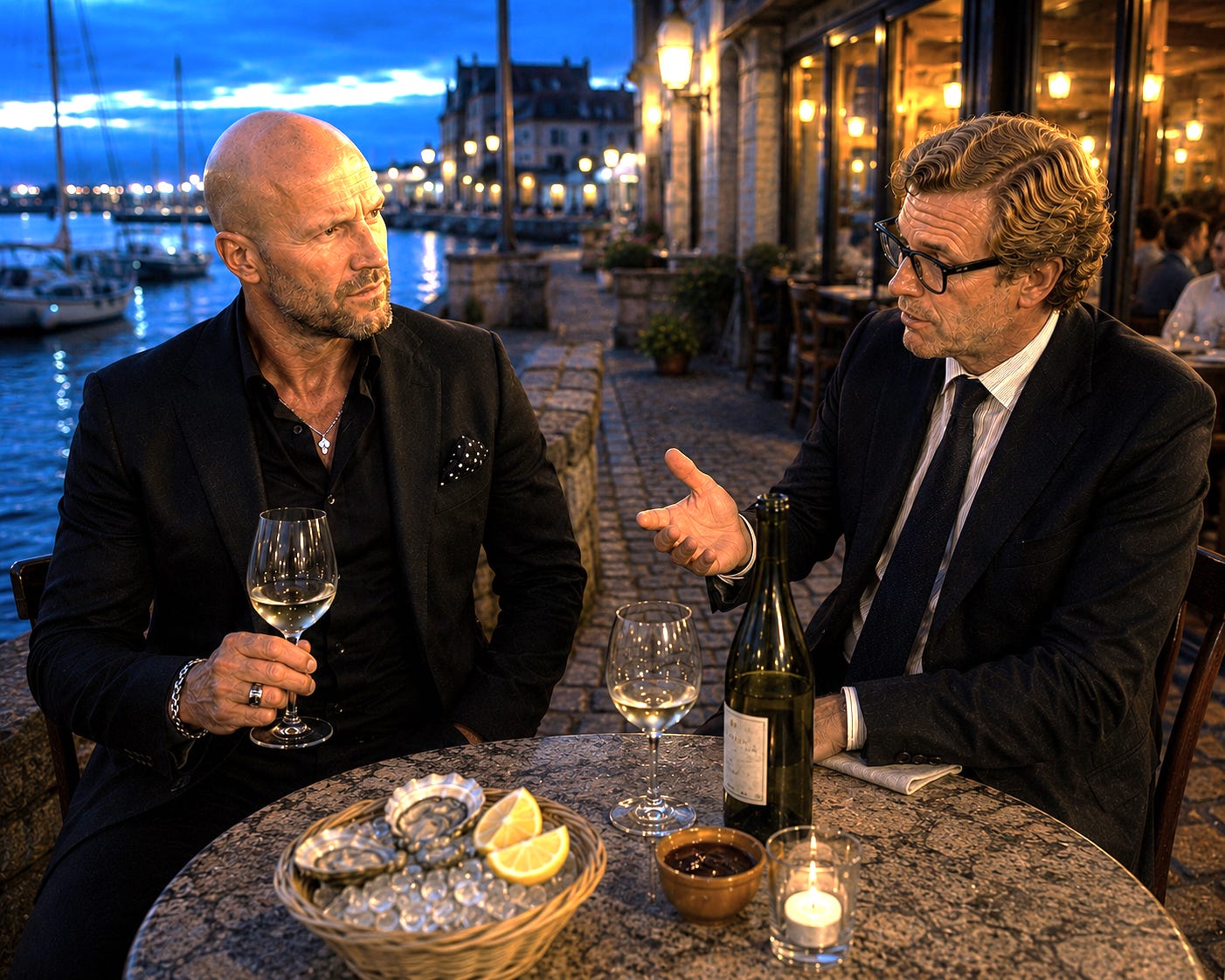
Doug disappeared into the cellar and returned a few moments later carrying five bottles.
He placed them carefully on the table, almost as though he was introducing old friends rather than wines.
Five bottles lined up in a neat row.
A clenched fist of Muscadet if you’d rather.
Doug, mate. “If I walked in here tomorrow,” and I said,
“Show me the Muscadet,” would these here, be the bottles?”
He looked at them for a moment. “I think they would.”
He gently rested his hand on the first.
Domaine de l’Écu.
A fitting place to start.
Guy Bossard and Domaine de l’Écu have become one of the region’s modern reference points, helping prove to the wine world that Muscadet could possess texture, complexity and a remarkable ability to age when treated seriously in both vineyard and cellar.
Doug poured and I took a sip. “Bone dry.”
He sounded like an impersonation of Michael Caine.
Calling great Muscadet bone dry felt a little like describing The Beatles as quite musical.
Technically accurate but hopelessly incomplete.
The second bottle came from Domaine Vinet.
“I’ve always admired this family,” Doug said. “It’s bone dry. Look at the year.”
I’d spent years hearing people insist Muscadet should always be drunk young.
Within seconds that idea had quietly collapsed into my glass. It was 2017.
Bottle number three was Luneau-Papin.
The wine still possessed freshness, but now there were layers of toasted almond, warm bread, dried citrus peel and something almost smoky beneath it all. It felt complete. “It was bone dry - I wasn’t expecting this.”
For decades Muscadet had been judged almost entirely by its cheapest examples. High yields, supermarket shelves and anonymous bottles had somehow become the public face of an extraordinary region.
Meanwhile, growers quietly carried on making wines that hardly anybody outside the Loire ever tasted.
La Pépière came next.
Doug smiled before he even poured it. “If Muscadet has a cult wine...”
“This might be it.” He wasn’t exaggerating. “It’s bone dry. Bone. Dry.”
The final bottle was Jo Landron.
“If somebody asked me to explain modern Muscadet...”
“I’d probably pour this. It’s bone dry Landron.”
The wine was vibrant, energetic and alive without ever becoming loud.
Like everything that evening, seeming entirely comfortable in its own skin.
Each one seemed to reveal another layer of the region.
Five bottles.
Five personalities.
Five different conversations.
Each Bone dry.
I looked across at Doug.
“So... I have to ask. When did Michael Caine become a sommelier?”
He burst into laughter.
“I wondered how long you’d last.”
The photograph I’d seen earlier was real.
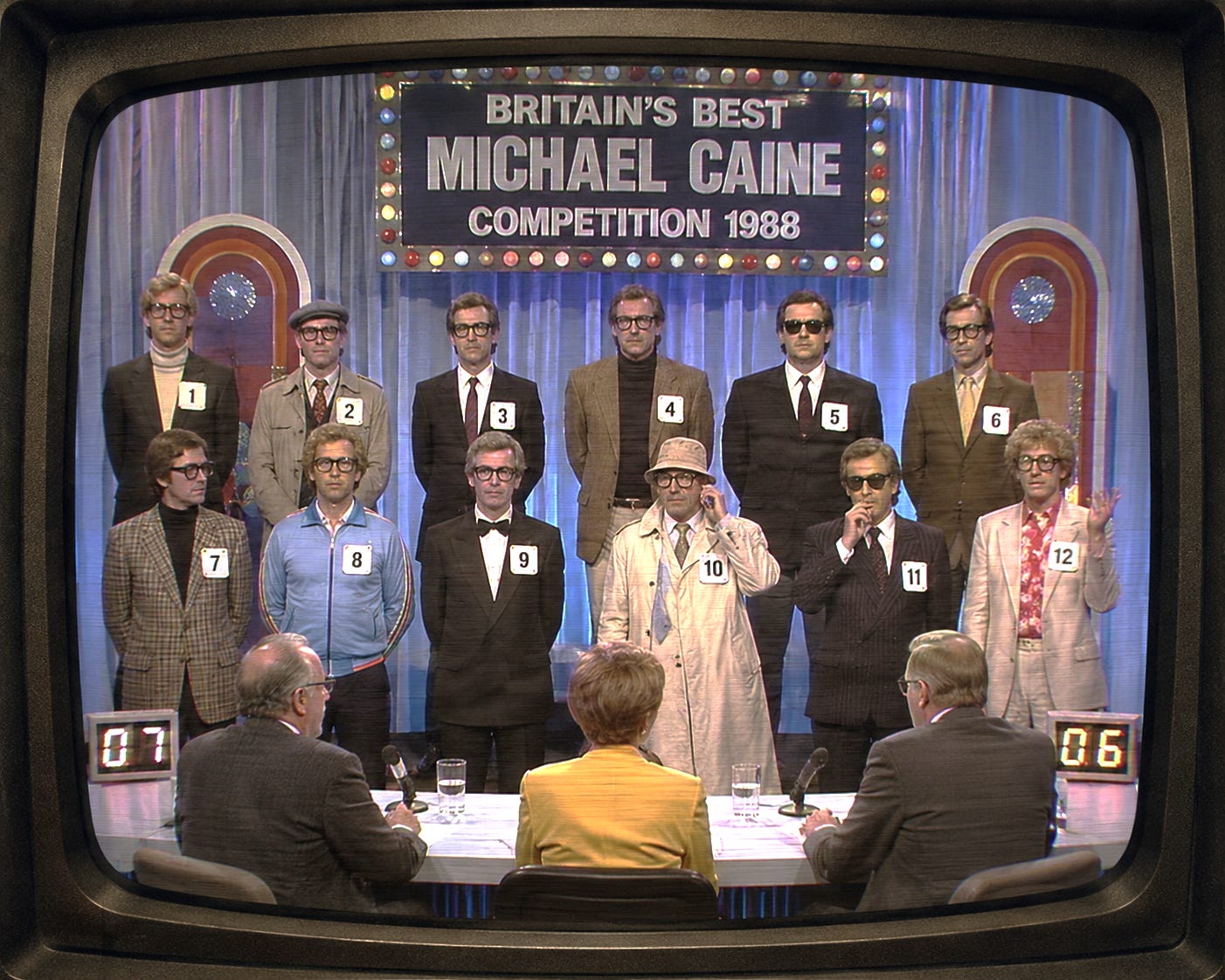
In the late 1980s Doug had genuinely won a televised Michael Caine impersonation competition. Regional television.
Anne Robinson from The Weakest Link was a judge.
Saturday evenings. Twelve Michael Caines and three judges.
“It was tremendous fun,” he admitted. “I spent years studying him.
Most impersonators spent their lives trying to sound like Michael Caine.”
Doug smiled. “I wanted to understand why he paused.”
“Why he looked away before a line.”
“Why he lowered his voice instead of raising it.”
“Turns out...those are exactly the same skills you need for a wine program”
He looked around the restaurant. “I was watching the tiny little details.”
Looking back across the dining room, it suddenly became obvious.
Doug wasn’t a brilliant sommelier because he’d spent his youth impersonating Michael Caine. He was brilliant because he’d spent half his life studying an iconic actor with extraordinary care: the pauses, the glances, the hesitations and all the tiny details most people overlook.
Funny thing was, after five bottles and an evening with Doug, bone dry no longer sounded like the end of the description.
It sounded like the beginning.
Bone dry, as Doug would say.
But never just bone dry.


