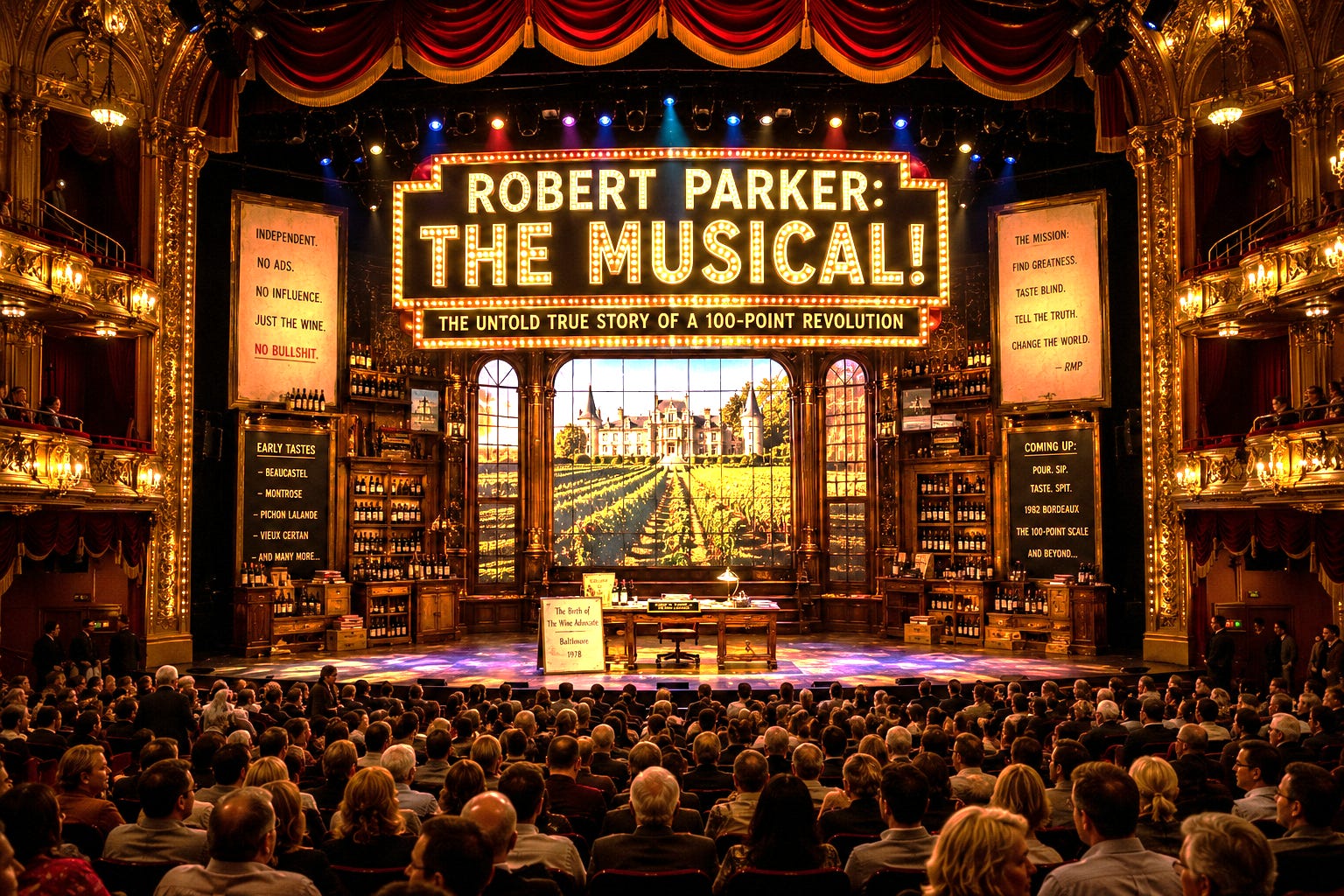
“The most influential wine critic in history finally gets the Broadway treatment he neither wanted nor requested.”
— The Indelible Wine Stain
There are moments in theatre when one finds oneself questioning not only the artistic judgement of a producer, but perhaps the entire trajectory of human civilization.
Such a moment occurred approximately twelve minutes into Robert Parker: The Musical, when a chorus line of dancing Champagne flutes descended from the rafters of the Bowery Theatre while singing in four-part harmony about the secondary market for Bordeaux futures.
By rights, this should not work.
A lavish Broadway musical based upon the life of a Maryland lawyer turned wine critic sounds less like a theatrical proposition and more like the result of a lost bet between several intoxicated sommeliers. Yet against all logic, common sense and the repeated warnings of financial advisers, Robert Parker: The Musical emerges as one of the most entertaining productions of the decade, perhaps the century.
The story follows Robert Parker’s journey from his modest Baltimore dairy town and kitchen table to becoming arguably the most influential wine critic in history. The production wisely avoids presenting Parker as either hero or villain. Instead, he is portrayed as something far more interesting: a man whose opinions became larger than he ever intended.
“The finest wine-based musical since Bottleshock the Musical.”
— Benjamin Boublebaarth
It opens not in Baltimore, but in rural France.
A young Robert Parker arrives armed with little more than curiosity, an affection for dairy products, and a belief that milk represents the pinnacle of fermented civilization. There he meets Patricia, the woman who would become his wife, and through her discovers an entirely new world.
The opening duet, Milk to Wine, is one of the evening’s most unexpectedly charming moments.
Patricia sings of vineyards, villages and family meals. Robert counters with earnest observations about cream content, freshness and the subtle differences between dairy producers. What begins as a romantic comedy gradually transforms into a revelation. As the pair wander through French cafés and wine bars, Parker starts applying the same obsessive curiosity he once reserved for milk to the wines before him.
“If one cow tastes different from another...” he sings,
“Then why not one vineyard tastes different than the next?”
Patricia smiles knowingly.
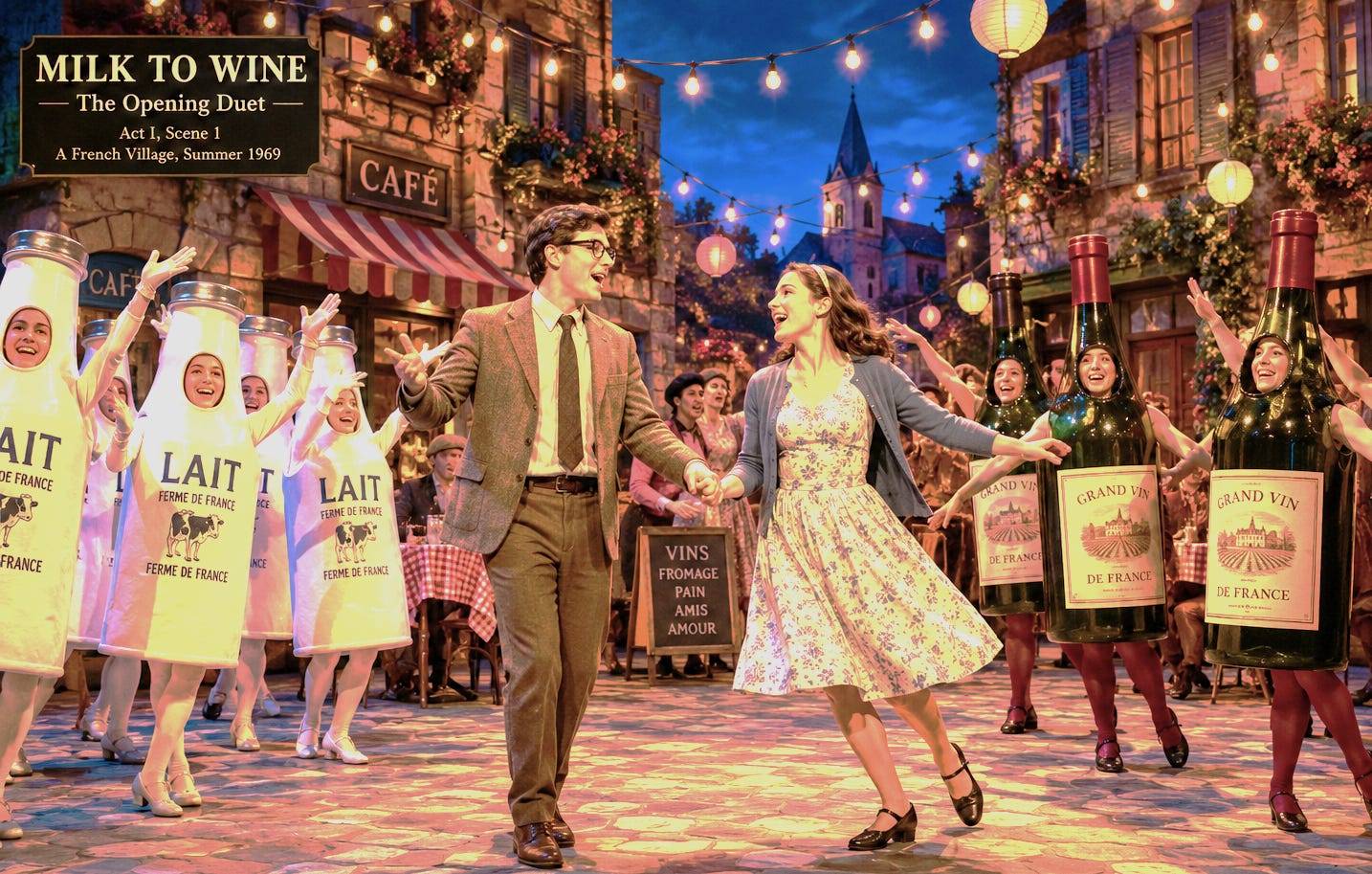
By the song’s finale, the audience watches two love stories unfold simultaneously: Robert and Patricia fall in love, and Robert falls in love with wine.
The number concludes beneath a canopy of lanterns as the young couple dance through a French village square as a chorus of singing milk and wine bottles persuade Parker to abandon dairy as his primary intellectual pursuit.
It is, against all odds, utterly delightful and against all delights, utterly odd.
Following this, we fast-forward years to the next big musical number.
The Baltimore-Washington Wine Advocate, introduces us to Parker seated at a kitchen table surrounded by bottles, notebooks and unpaid subscription invoices.
The set is beautifully realized. Warm amber light floods the stage. The audience can almost smell the coffee and freshly typed newsletters. It is an intimate beginning that makes the spectacle to come all the more remarkable.
The first major showstopper arrives in the form of Pour. Sip. Taste. Spit.
A glorious mechanized production number depicting Parker’s tasting routine.
The machine-esque rhythm of the chant of “Pour, Sip, Taste, Spit” creates the marching back-bone of the song and paints the picture of Parker’s grueling and arduous daily tasting schedule as he summons points for the judgement.
Dancers dressed as tasting notes march across the stage sitting somewhere between a precision military parade and a Telluride steam locomotive.
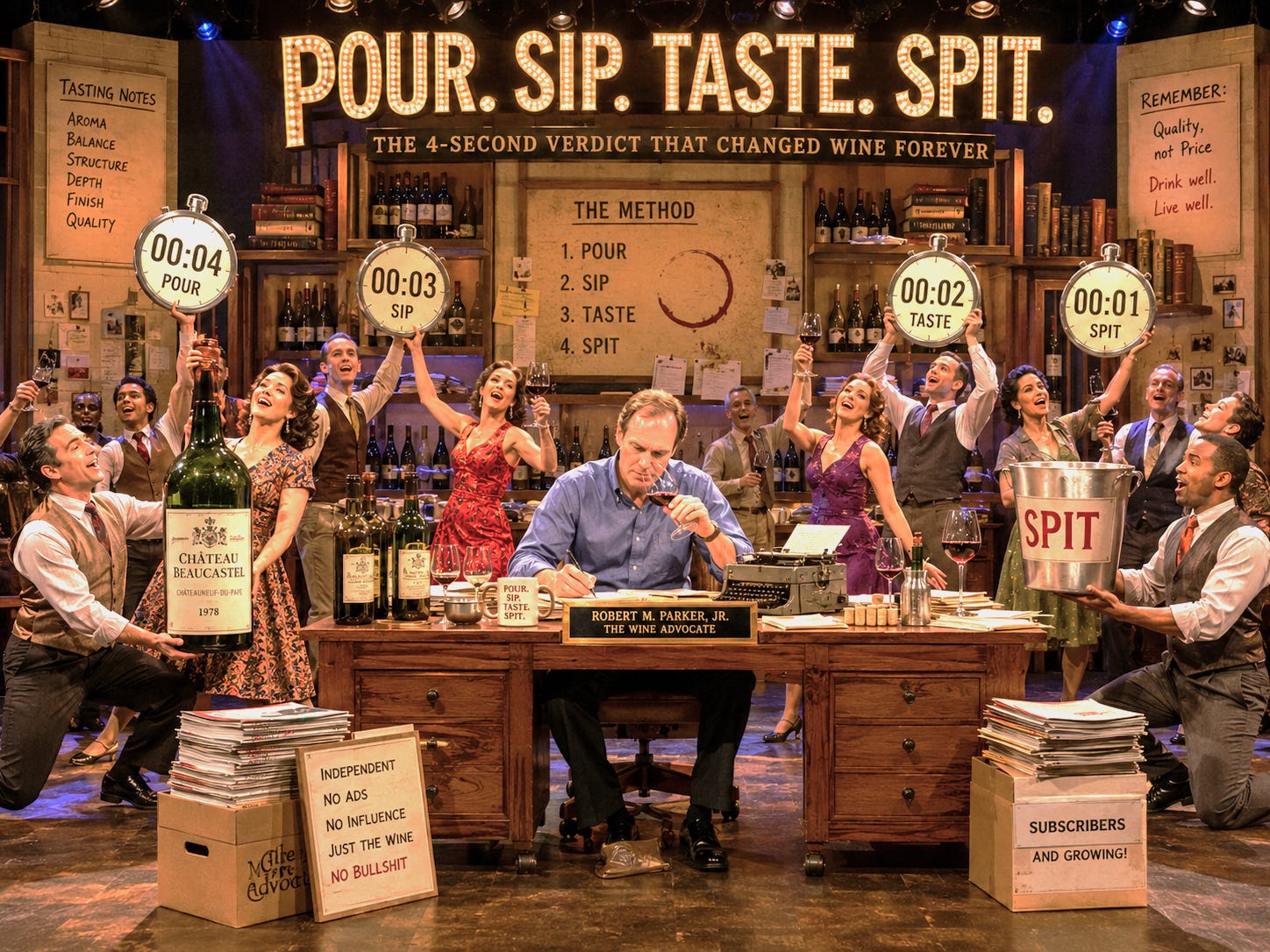
“Pour! Sip! Taste! Spit!”
”Pour! Sip! Taste! Spit!”
The number builds in intensity as scores begin flying across giant illuminated scoreboards.
“Ninety-two!”
”Ninety-four!”
”Ninety-six!”
By the finale, Parker appears less like a wine critic and more like a benevolent tasting machine powered entirely by Cabernet Sauvignon.
The production truly finds its footing during Nineteen Eighty-Two, a dramatic retelling of the Bordeaux vintage that transformed Parker’s career.
Here we meet Robert Finigan, portrayed with magnificent theatrical indignation by Charles Wetherby. The celebrated duet The Duel recreates the disagreement between Parker and Finigan regarding the greatness of the vintage.
Performed upon a split stage representing Baltimore and New York, the two critics exchange increasingly elaborate insults disguised as tasting notes.
“My dear Robert...” sings Finigan, “your enthusiasm exceeds your experience.”
To which Parker replies:
"My dear Robert...your experience exceeds your enthusiasm.”
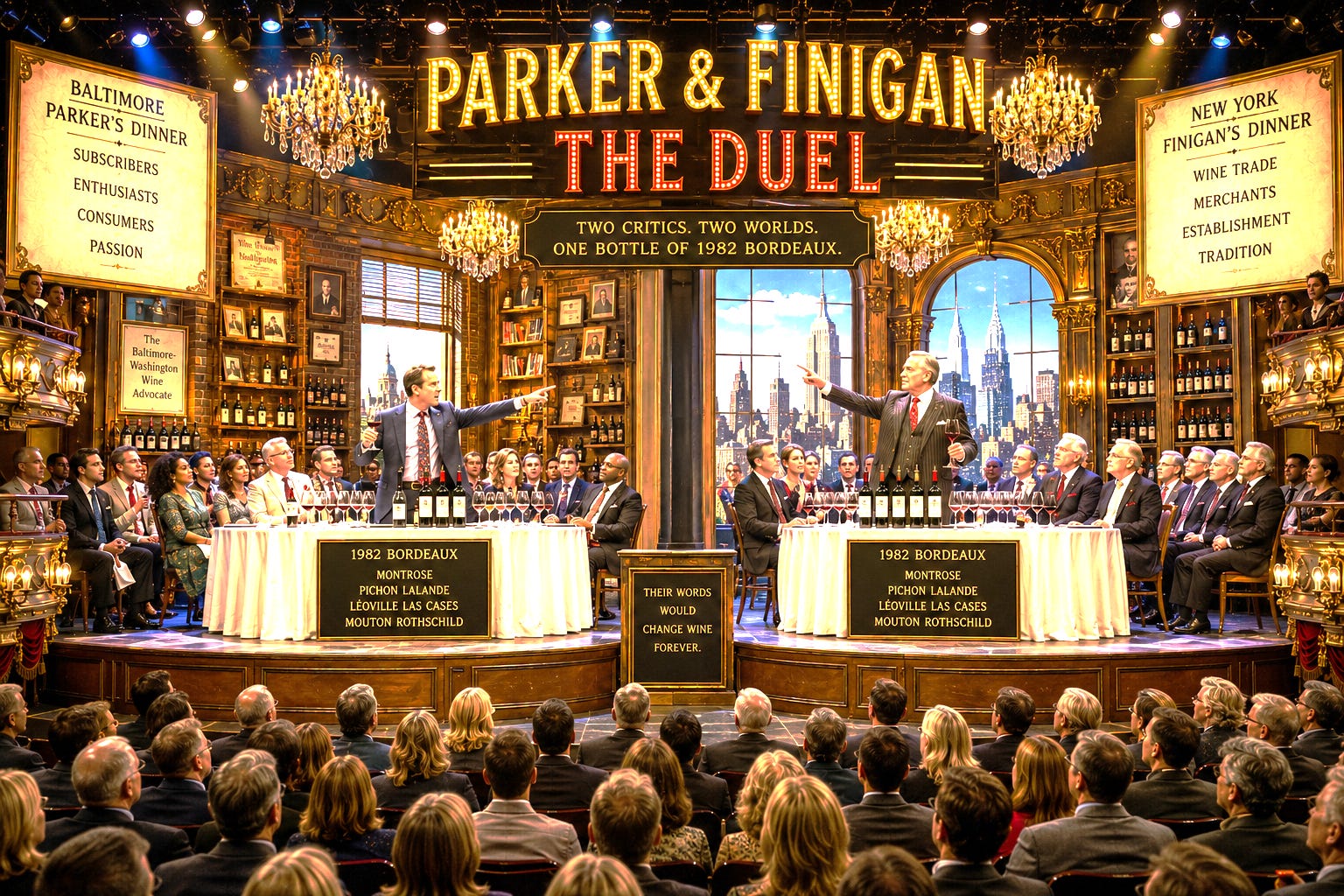
It is theatre of the highest order.
One could argue that this scene alone justifies the ticket price.
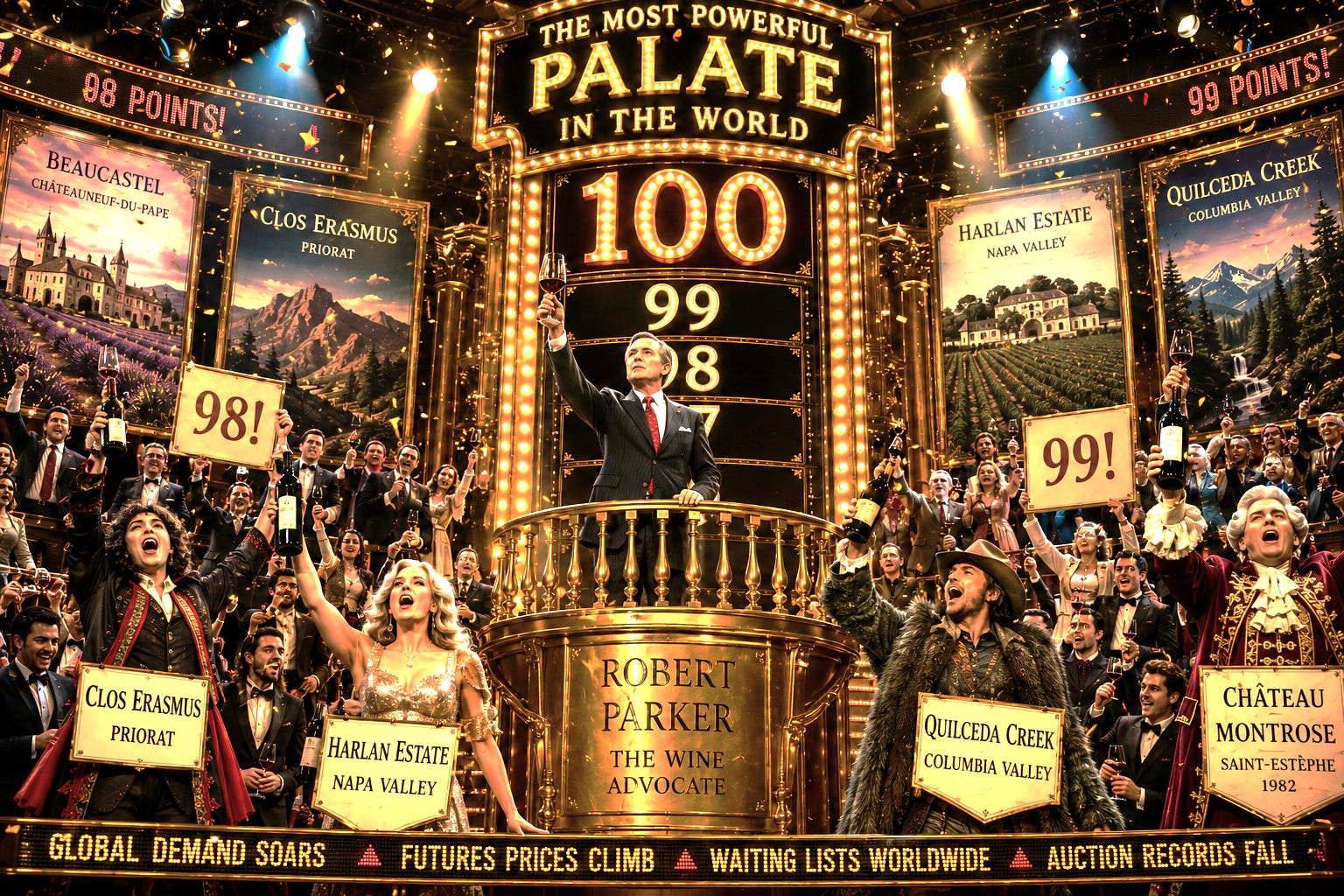
The first act closes with The Most Powerful Palate in the World, a dazzling spectacle in which merchants, collectors, importers and producers’ whirl around Parker as if caught in the gravitational pull of an increasingly influential solar system.
A giant illuminated 100-point scale rises from the stage floor.
Wine merchants faint.
Auctioneers weep.
Collectors wave paddles.
Importers clutch allocation sheets.
The audience erupts.
“I laughed, I cried, I cried laughing and laughed crying.”
— Decanting Monthly
Act Two takes a more reflective turn.
Particularly moving is The Flying Winemaker, a tribute to Michel Rolland.
Following Rolland’s passing earlier this year, the production wisely rewrote this part and choose affection over caricature. Rolland is presented not as a symbol of controversy but as a globe-spanning consultant attempting to help vineyards express themselves.
Standing before a giant rotating globe, he sings the evening’s most beautiful lyric:
“I never made the vineyard.
I only helped it speak.”
The moment received spontaneous applause on opening night.
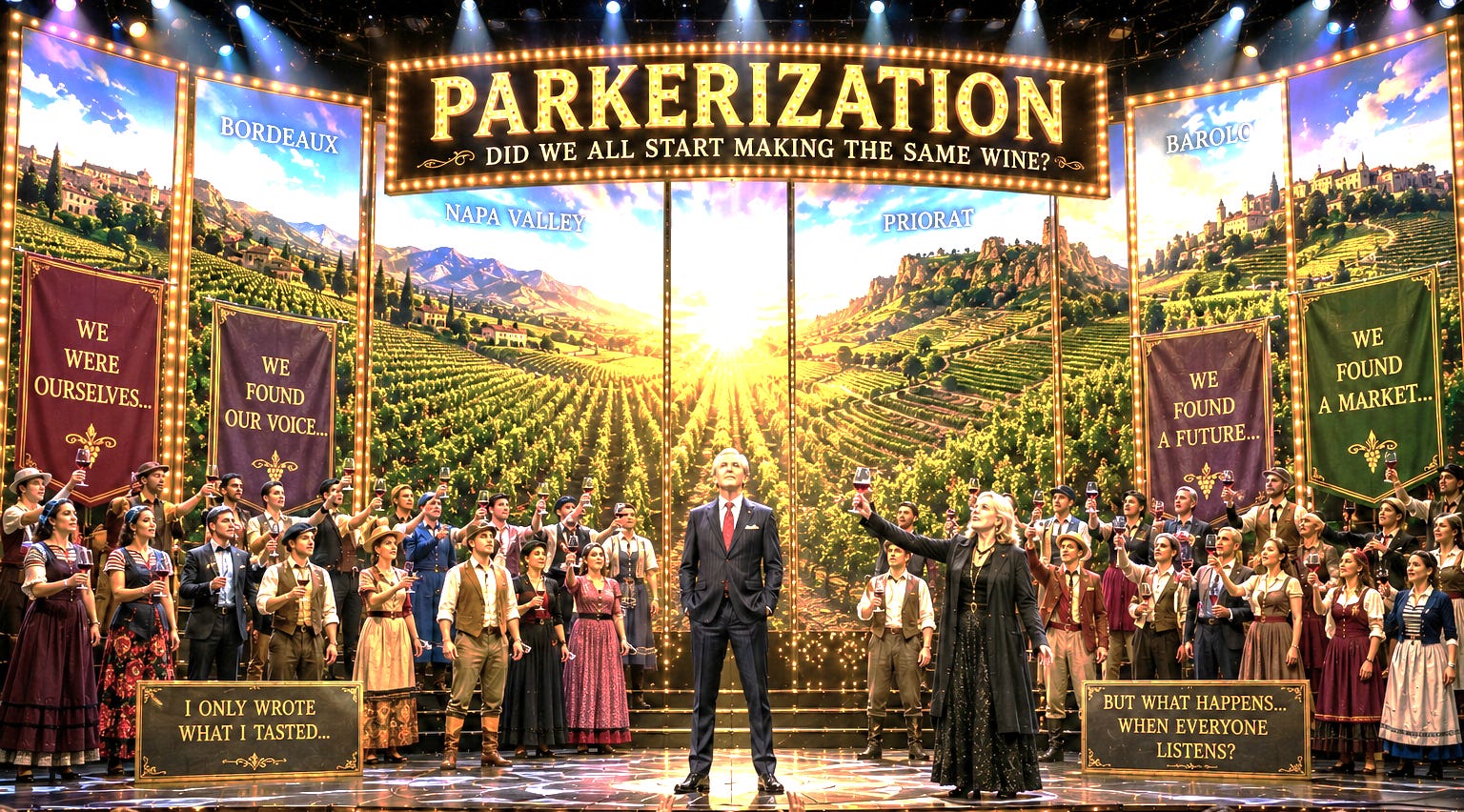
The show’s most intellectually ambitious sequence is Parkerization, which tackles the debate surrounding Parker’s influence on global wine styles. Here the musical introduces Jancis Robinson, portrayed with wit and elegance by Dame Penelope Featherstone.
As vineyards from Bordeaux, Napa, Priorat and Barolo slowly merge into a single theatrical landscape, Robinson poses the central question of the production:
“But what happens...
when everyone listens?”
For several seconds, the theatre falls silent.
One could hear a cork drop.
The production’s most daring sequence arrives midway through Act Two, during a dream-like tableau inspired by Mondovino. The stage transforms into a maze of vineyards, cameras and competing philosophies. Critics, consultants and producers chase Parker through an increasingly surreal landscape while arguing about terroir, globalization and the future of wine.
Vineyard rows slide across the stage.
Barolo becomes Napa.
Napa becomes Bordeaux.
Bordeaux becomes Napa.
The dance choreography involving the use of 36 conveyor belts deserves a Tony at least.
The audience laughs.
Then comes the scene that may already be destined for Broadway legend.
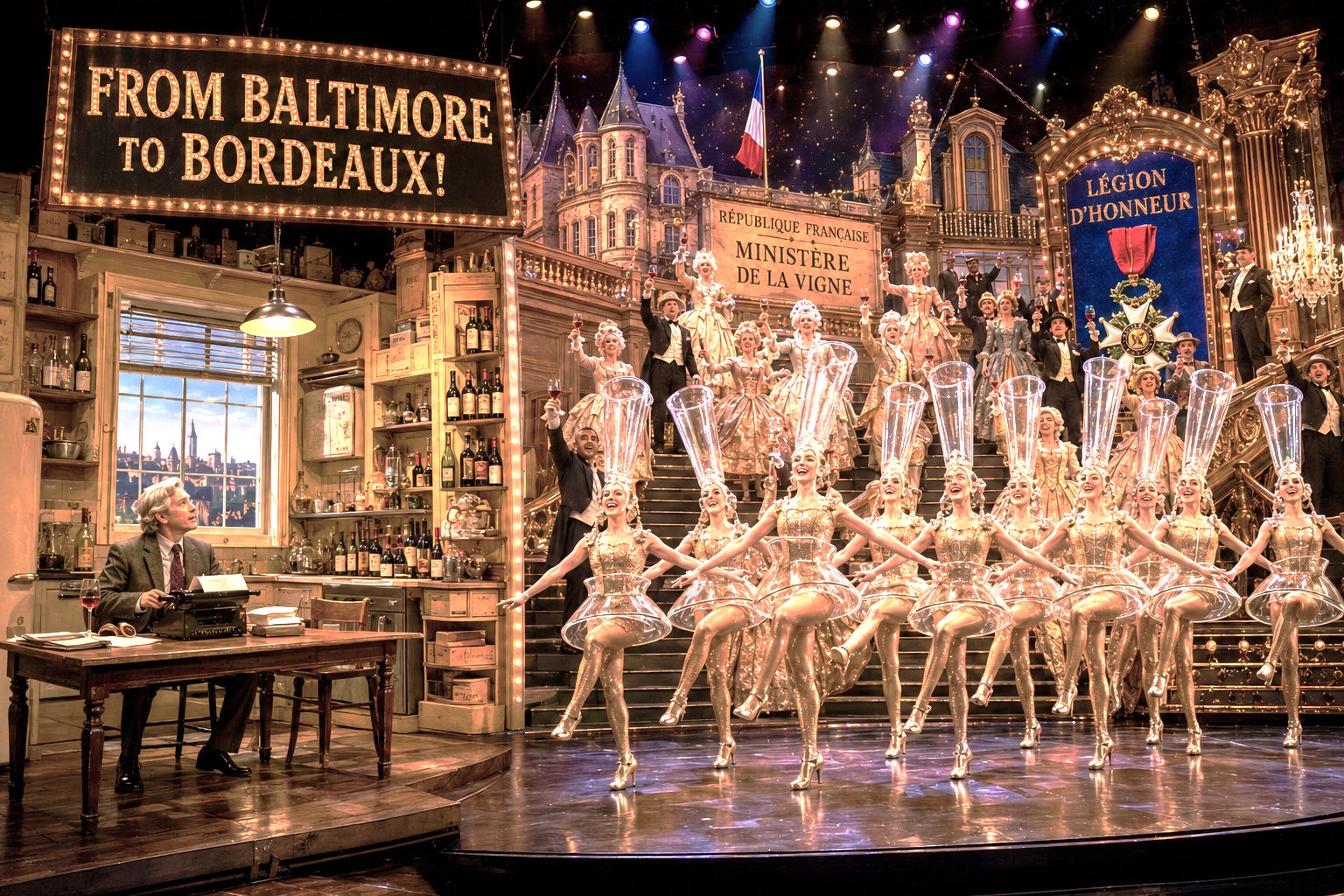
From Baltimore to Bordeaux begins with Parker seated once again in his modest kitchen.
What follows is perhaps the most astonishing set transformation currently operating on any stage in the world.
Bookshelves unfold into châteaux.
Wine racks become government ministries.
Kitchen cabinets transform into French palaces.
Within moments the entire French wine establishment has emerged from Parker’s dining room.
A chorus line of dancing Champagne flutes performs precision tap choreography while singing:
“Who is this American?”
“Why is he scoring our wine?”
“Why give him a medal when we review our own wines all the time?”
The sequence culminates in Parker receiving the Légion d’Honneur beneath a medal approximately the size of a studio apartment.
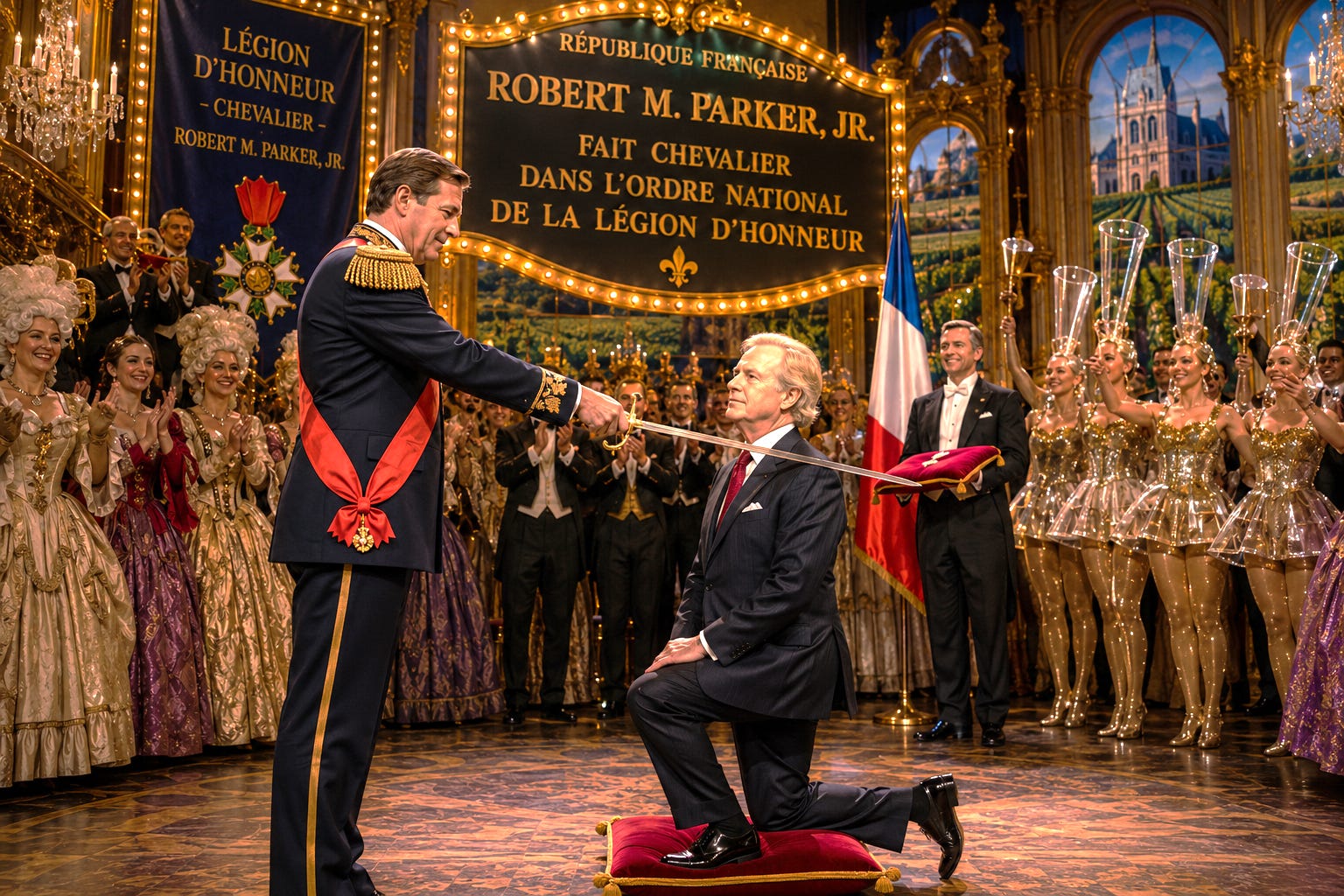
It is impossible not to see the humor but also feel so proud to be an American.
The emotional heart of the production arrives with The Wines He Found.
One by one, great wines enter the stage as characters.
Beaucastel.
Montrose.
Clos Erasmus.
Quilceda Creek.
Harlan Estate.
Le Pin, portrayed by a performer standing on a wooden crate due to his diminutive stature is scene-stealing here.
Each sings not about scores but about discovery.
The effect is unexpectedly moving.
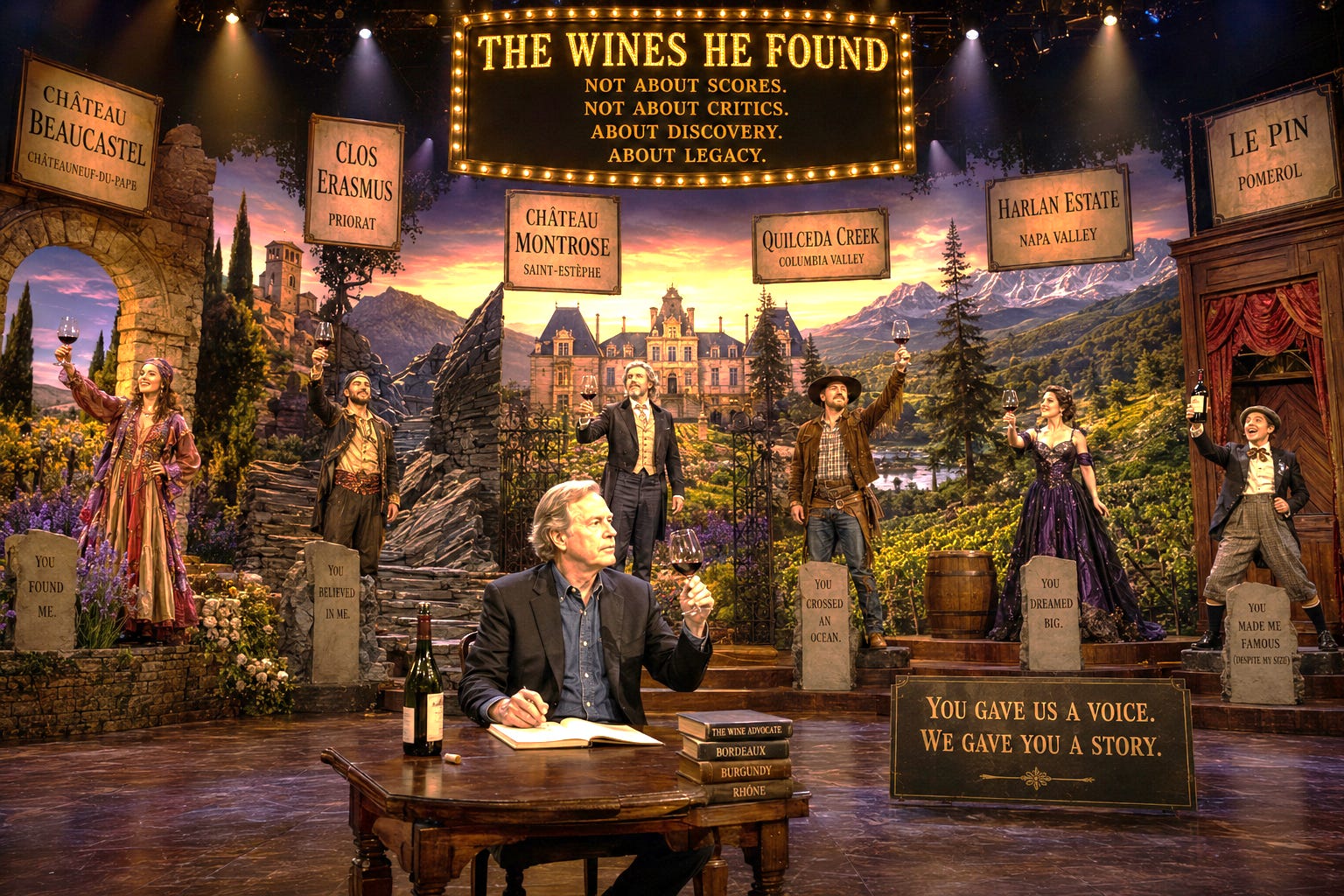
For all the debate surrounding Parker’s legacy, the production reminds us that thousands of wine lovers discovered remarkable producers because somebody cared enough to write about them.
The finale, 100 Parker Points, brings together every character from the evening.
Parker.
Finigan.
Robinson.
Rolland.
The dancing Champagne flutes.
The French court.
The wine merchants.
The wines themselves.
A giant illuminated “100” glows above the stage.
As the music reaches its climax, Parker steps forward and delivers the final line:
“They’re only numbers, what’s the fuss?”
The wines reply:
“But they brought us to people and people to us.”
The curtain falls as the last song fades gently out.
The audience rises.
One suspects even the most hardened wine professional may find themselves wiping away a tear.
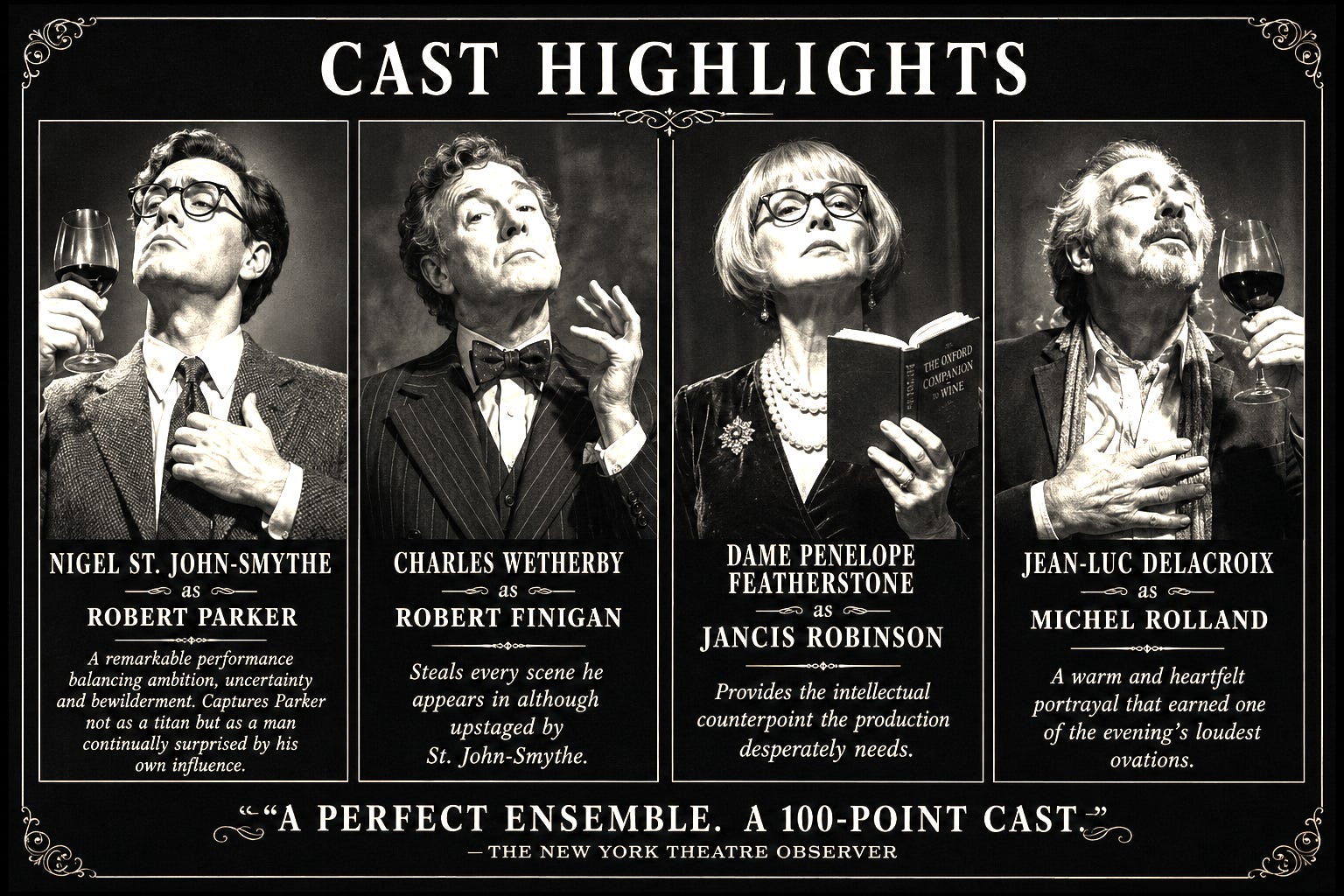
Cast Highlights
Nigel St. John-Smythe as Robert Parker
A remarkable performance balancing ambition, uncertainty and bewilderment. Captures Parker not as a titan but as a man continually surprised by his own influence.
Charles Wetherby as Robert Finigan
Steals every scene he appears in although upstaged by St. John-Smythe.
Dame Penelope Featherstone as Jancis Robinson
Provides the intellectual counterpoint the production desperately needs.
Jean-Luc Delacroix as Michel Rolland
A warm and heartfelt portrayal that earned one of the evening’s loudest ovations.
A Note from the Director
“People have asked why we made a Broadway musical about Robert Parker.
The answer is simple.
We originally intended to produce a musical about the “Grid,” the method of systematic tasting used by many modern wine schools.
Unfortunately, audiences struggled to emotionally connect with Act Three’s Medium-Medium Plus, Medium-Minus song and dance sequence.
Early previews of The Grid: The Musical proved particularly challenging.
Robert Parker, by comparison, was considerably easier to produce.”
Final Verdict
Like a mature bottle of Bordeaux, Robert Parker: The Musical is ambitious, occasionally excessive, occasionally controversial, ultimately unbelievable, and impossible to ignore.
The remarkable achievement of the production is that beneath the scoreboards, the dancing Champagne flutes, the giant medals, the French aristocracy and the Broadway spectacle lie something unexpectedly sincere.
It shows us that before the points, before the controversy and before the influence, there were simply wines and the people who loved them.
And that, perhaps, is worth a standing ovation.
“A 100-point production.”
— Wine Marketer
Rating:
★★★★★
An Indelible Wine Stain
An intoxicating triumph.